
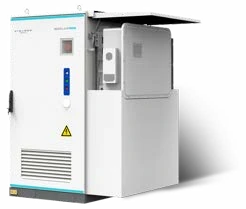
SOLVA DC261 is a 261kWh high-voltage battery cabinet for external hybrid or central inverter integration. Its integrated DC busbars are rated for 125kW. An external inverter must be specified separately and is not included with the battery cabinet. Its rating and the system’s operating limits determine the AC output available to the site. SOLVA technical brochure, p. 11.
This distinction makes the procurement brief more useful. You are selecting a battery cabinet and an external conversion arrangement, with the opportunity to match that arrangement to the project's electrical architecture. The inverter, controls and battery must be assessed as an exact combination.
Read the DC261 specifications at the correct boundary
| Parameter | Brochure specification |
|---|---|
| Total stored energy | 261kWh |
| System depth of discharge | 90% |
| Integrated DC busbars | Rated for 125kW |
| Nominal battery voltage | 832V DC |
| Operating voltage, minimum to maximum | 728–936V DC |
| External inverter communication | CAN bus |
Source: SOLVA technical brochure, p. 11. An inverter's compatible operating range must be checked against the battery's operating window, not just its nominal voltage.
Define who approves the complete combination
Ask for an integration schedule naming the battery configuration, external inverter model, firmware and communications settings. It should identify the party responsible for confirming the combination and the documents used for that decision. A supplier's preliminary selection should be distinguishable from the configuration approved for installation.
Use the schedule to resolve the boundary between battery supply and inverter supply. Who provides the communications cable and settings? Who checks the proposed mounting arrangement? Who commissions charging limits and verifies that the inverter responds to battery commands? Record the answers against named deliverables so an omitted interface does not emerge during installation.
If the project includes existing equipment, provide its exact model and configuration rather than assuming that an established inverter can simply be retained. Request the same documented assessment for reused and newly supplied equipment.
What should an inverter integration review cover?
DC261 offers a side-mounting option for a suitable external hybrid inverter. Confirm the inverter model, battery interface and mounting arrangement together, so the physical layout and electrical design suit the equipment in the proposal. SOLVA technical brochure, p. 11.
- Electrical range: identify the inverter's battery input limits, startup conditions and permitted operation across the applicable DC voltage window.
- Current capability: establish continuous charging and discharging limits for the complete combination, including any conditions that reduce available power.
- Communications: confirm the required CAN protocol, firmware versions, settings and responsibility for integration support.
- Operating modes: specify whether the project needs grid-connected operation, backup, islanded operation or generator interaction, and obtain confirmation for each requested mode.
- Protection and commissioning: request the approved protection arrangement and a test plan covering shutdown, restart, communications loss and operating limits.
Use the FWA inverter compatibility page to begin the enquiry, then obtain confirmation for the exact SOLVA DC261 and inverter model. A general brand listing does not resolve firmware, voltage or project-specific operating requirements.
Why voltage affects the integration calculation
Consider an illustrative constant 125kW at the DC interface. Convert power to watts before calculating current: 125kW = 125,000W, and current equals power divided by voltage. At 832V, the arithmetic is 125,000 ÷ 832 ≈ 150.2A. At 728V it is approximately 171.7A; at 936V, approximately 133.5A. The voltage inputs and busbar power figure come from SOLVA technical brochure, p. 11.
This hypothetical calculation assumes constant DC power and uses terminal voltage directly. It illustrates why checking only nominal voltage can overlook a more demanding current condition. These results are not published battery current ratings, proof that 125kW is available throughout the voltage window, or values for selecting cables and protection. The approved equipment limits and engineered installation govern the design.
Compare a proposed current limit with the load requirement
Extend the current example using an invented external inverter with a 150A continuous DC input limit. At 832V, voltage multiplied by current gives 832 × 150 ÷ 1000 = 124.8kW. At 728V, the same assumed current limit gives 728 × 150 ÷ 1000 = 109.2kW. Dividing by 1000 converts watts to kilowatts. These figures illustrate one hypothetical constraint; they are not specifications of an approved inverter.
If a proposal promises a constant duty, ask how that duty is maintained across the assessed voltage range. A calculation at nominal voltage alone would not answer the question in this example. Battery limits, the DC connection rating, inverter limits and conversion losses must all be considered before stating an available AC output.
Request the proposed operating envelope in a form the site team can use: the conditions under which the requested load is supported, the conditions that restrict it and the intended control response. Any restriction should be visible in the proposal, not discovered by interpreting separate equipment brochures after purchase.
Separate battery expansion from inverter expansion
DC261 supports up to 12 cabinets in DC parallel with an additional controller. External inverters can be arranged in AC parallel as part of the system design. Plan battery expansion and inverter capacity separately: adding storage extends the energy available but does not automatically increase AC output. SOLVA technical brochure, p. 11.
Ask the equipment schedule to identify cabinet quantities, external inverter quantities, the controller, connection equipment and the responsibilities for commissioning. For staged projects, establish which components need provision for the later stage and whether the proposed controls support the final arrangement.
Frame expansion around the problem being solved. If the intended load power is unchanged but the operating period grows, ask the designer to assess additional energy. If new machinery raises the peak load, ask for a separate assessment of the external inverter and the complete power path. Both changes may be relevant, but they should have separate requirements and acceptance criteria.
For each stage, identify the minimum operating configuration during maintenance and the consequences of taking equipment out of service. Do not assume that a parallel arrangement provides a particular level of redundancy; ask the supplier to demonstrate the proposed behaviour and document the remaining duty.
Keep integration support practical after commissioning
Include a handover record of the approved firmware, settings, commissioning results and contact responsibilities. Ask how a future firmware update or inverter replacement will be assessed before it is applied. Establish who can interpret an alarm spanning the battery and inverter, and which operating records they will need. This makes support arrangements part of the buying decision alongside equipment ratings.
Ask the quotation to distinguish equipment supply, integration work and commissioning responsibilities. If an inverter model changes before delivery, require the combination to be reassessed against the original duty. Record any resulting change to power limits, operating modes or included equipment so the replacement is evaluated on the same basis as the initial selection.
When should you compare AC261?
SOLVA AC261 has the same listed 261kWh total energy but includes a 125kW PCS with 400V AC output. That makes the integration boundary different from DC261. Compare the complete installed scope, including the external inverter and associated equipment on the DC261 side, before comparing prices or physical layouts. SOLVA technical brochure, p. 6; SOLVA technical brochure, p. 11.
Read the AC261 commercial storage guide for the integrated approach. To progress a DC261 design, review the FWA storage range, retain the brochure from downloads, and send FWA your proposed inverter model, firmware, load profile and single-line diagram.
Frequently asked questions
Does SOLVA DC261 include a 125kW inverter?
No. DC261 has 125kW DC busbars and requires a separately specified external inverter. Include the inverter, controls and integration work in the proposal.
Will DC261 work with every inverter from a listed brand?
Confirm compatibility for the exact inverter model, battery configuration, firmware, communications and intended operating modes.
What voltage does DC261 use?
DC261 has 832V nominal and a 728–936V DC operating window. Both the full operating range and the inverter requirements need review. (SOLVA technical brochure, p. 11.)
Does adding cabinets increase AC output?
Additional battery capacity does not automatically increase inverter output. DC261 supports up to 12 cabinets in DC parallel with an additional controller; external inverter capacity is a separate design decision.