
The new Freedom Won marine range offers three IP66 models with different voltage, capacity and continuous-current ratings. They sit alongside the established LiTE2 range, giving vessel owners a choice of storage options to assess against the onboard electrical system and intended duty.
Which new marine models are listed?
| Model description | Model code | Continuous charge/discharge |
|---|---|---|
| 52V 10/8kWh | TNB6F146 | 100A |
| 52V 16/13kWh | TNB6F147 | 200A |
| 96V 30kWh | TNB6F148 | 150A |
Marine model specifications. Download the updated marine flyer for the range overview.
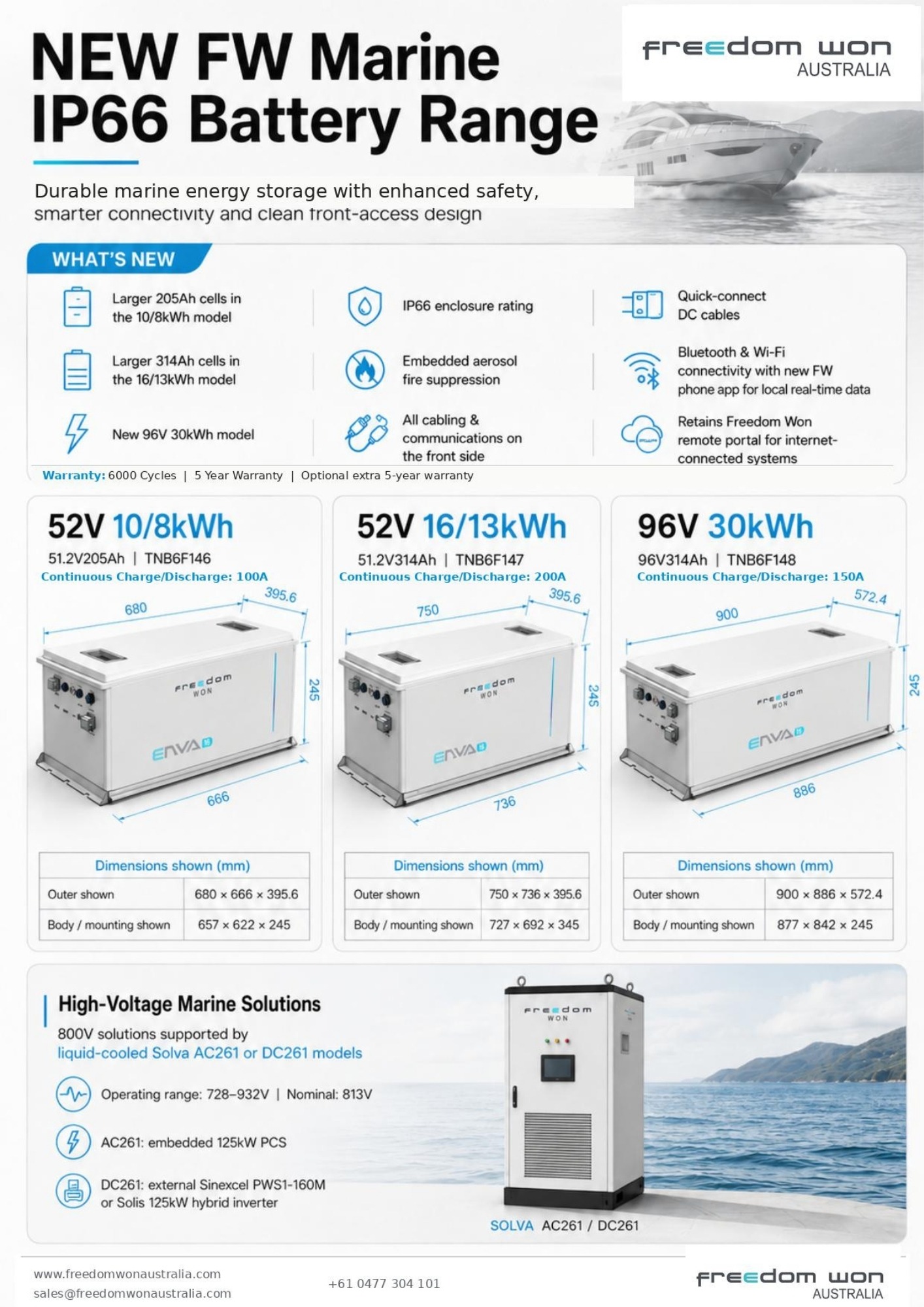
Use the model code when requesting documentation or discussing a proposal. This helps identify the intended unit when product names, nominal voltages and range descriptions appear in different documents.
Designed for marine energy storage
The new models feature IP66 enclosures, embedded aerosol fire suppression, front-access cabling and communications, and quick-connect DC cables. Bluetooth and Wi-Fi connect with the Freedom Won phone app for local monitoring, while internet-connected systems can use the remote portal.
Ask which monitoring functions and connections will be included in your proposed installation. Record the answers in the equipment and commissioning documentation so the operating requirements are clear.
Compare each model on the same basis
TNB6F146 combines a 51.2V battery with 205Ah cells and a 100A continuous charge/discharge rating. TNB6F147 uses 51.2V, 314Ah cells and a 200A continuous rating. TNB6F148 uses 96V, 314Ah cells and a 150A continuous rating. Compare voltage and current together: the highest energy capacity does not necessarily have the highest current rating.
Select the inverter and charging equipment alongside the battery. Their operating limits, conversion losses and controls affect the power available onboard and the time it can be sustained. A complete proposal should identify the battery model, inverter, charging sources and intended loads.
Build an energy budget around life on board
List the equipment you want to run and the period during which it will need battery power. Separate predictable overnight use from occasional high-demand equipment. Record both average energy use and the loads that may operate together. Include the existing charging sources and the likely opportunities to recharge, so the discussion covers the complete operating cycle.
For example, an assumed continuous 200W load running for ten hours uses 2kWh. A separate 1kW appliance used for half an hour adds 0.5kWh. Together, those hypothetical loads need 2.5kWh at the load side before allowing for conversion losses, reserve or additional equipment. This is an arithmetic example, not a typical vessel profile or a product-runtime prediction. Measure or obtain the actual equipment consumption before using it in a proposal.
Ask the designer to explain how simultaneous loads and starting demand will be handled. An energy budget can look modest while several appliances together require a higher power output. Our battery sizing guide explains why the stored-energy figure and the power requirement should remain separate throughout the selection process.
Check the charging plan as well as the discharge plan
Charging design needs to account for the selected battery’s continuous-current limit and the vessel’s available charging sources. Provide the exact details of existing chargers and any proposed additions. Agree the operating conditions, communications and equipment combination before installation so charging can be coordinated across the system.
Describe the periods when charging is expected to be available and the battery state you want before the next operating period. A system intended for frequent access to charging can have a different operating brief from one expected to support longer intervals between charging opportunities. The project team needs that information before recommending capacity, reserve or a charging strategy.
What should you compare before choosing a model?
Begin with the vessel’s electrical architecture and the equipment the battery will support. The operating voltage, intended load, charging arrangement and inverter integration all belong in the same assessment. A capacity figure alone provides only part of the information needed to select a system.
For the installation proposal, request the current model-specific datasheet, verified dimensions, mounting requirements, connection details and applicable warranty. Ask the responsible designer to identify the requirements for the vessel and intended use.
Where does LiTE2 fit in the range?
The established LiTE2 models remain part of our marine product range. Find their installation manual, range overview and model-specific specification sheets in the download centre, alongside information for the new IP66 range.
Treat a refit as a system review
When replacing an existing battery, record its exact model, voltage, connected equipment and the reason for the change. You may want additional energy, improved access to data, or a different arrangement of loads. Share photographs and existing equipment schedules with the responsible professional, then ask which components can be retained and which require assessment or replacement.
The LiTE2 marine comparison is useful for identifying the earlier range. It should not be used to transfer the new models' enclosure rating, current figures or connectivity features to an older unit. Ask FWA to confirm support and supply for the specific model being considered, especially where documents refer to different generations.
Make monitoring part of the handover
Local app monitoring and remote portal access serve different needs. Ask the installer to demonstrate what you can see locally and which functions need an internet connection. Agree who will receive the handover, how to interpret the normal readings and who to contact about an alert.
Keep the model code, approved documents and commissioning record with the vessel's operating information. A useful handover explains the normal operating indications, the procedures supplied for the installation and the route to technical support. It also records which functions were demonstrated. That gives the owner a clear reference after installation and makes subsequent service discussions more specific.
What about larger marine storage projects?
Higher-voltage marine projects can consider SOLVA AC261 or DC261 configurations. Their power-conversion approaches differ, as our SOLVA configuration guide explains. Arrange a project-specific review of the vessel’s electrical requirements, inverter arrangement and installation constraints before choosing a model.
Contact Freedom Won Australia with the proposed application, system voltage and equipment details to begin that conversation.
Keep a complete installation record
Retain the approved equipment schedule, current datasheets, applicable warranty, commissioning record and operating instructions. Where a general flyer and a detailed datasheet differ, obtain a confirmed model-specific answer before finalising the design. This is particularly useful when comparing older LiTE2 models with the new IP66 products.
To discuss the marine range, contact Freedom Won Australia with the vessel application, intended model, existing equipment and load budget. We can help focus the selection on a suitable storage option and the integration requirements for your proposal.
Frequently asked questions
Where do the new marine models appear?
The three new IP66 models appear first, followed by the existing LiTE2 marine range.
Where can I obtain the marine documentation?
The download centre contains marine manuals, specification sheets and the IP66 range flyer. Use the documents for the exact model and generation in your proposed installation.
Does a higher kWh model always have a higher current rating?
No. TNB6F146 is rated at 100A continuous charge/discharge, TNB6F147 at 200A and TNB6F148 at 150A. Compare voltage, current and energy capacity for the exact model.