
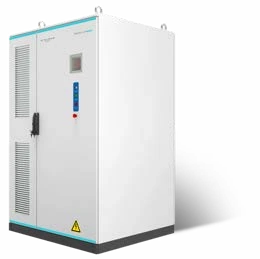
SOLVA AC418 and DC418 each provide 418kWh of total battery storage, but they connect to a project differently. AC418 includes a 215kW PCS with 690V AC output. DC418 has integrated DC busbars rated for 210kW and is designed for external high-voltage central inverter integration. The decision is primarily about system architecture, not a simple comparison of two inverter power ratings. SOLVA technical brochure, p. 16; SOLVA technical brochure, p. 18.
Compare the specifications side by side
| Parameter | SOLVA AC418 | SOLVA DC418 |
|---|---|---|
| Total battery energy | 418kWh | 418kWh |
| System depth of discharge | 90% | 90% |
| Listed power figure | 215kW integrated PCS | 210kW integrated DC busbars |
| AC interface | 690V output, −15% to +15%; three phases and protective earth, no neutral | Determined by the separately selected inverter |
| Nominal battery voltage | 1331.2V DC | 1331.2V DC |
| DC operating window | 1164.8–1497.6V | 1164.8–1497.6V |
| Dimensions, H × W × D | 2400 × 1350 × 1500mm | 2400 × 1350 × 1350mm |
| Weight | 3.8 tonnes | 3.7 tonnes |
Sources: AC418, SOLVA technical brochure, p. 16; DC418, SOLVA technical brochure, p. 18. Both dimensional specifications carry a ±5mm tolerance. DC418's busbar rating is not an external inverter output specification.
Start with the site's electrical connection
Ask the designer to mark the proposed battery connection on the site's single-line diagram before comparing equipment prices. Identify the distribution voltages, the relevant switchboards and transformers, and the point at which the required power will be measured. The chosen architecture must address that connection, alongside the site's operating duty.
Clarify which equipment exists, which can be retained subject to assessment and which must be supplied. An AC418 quotation and a DC418 quotation can place different equipment outside the cabinet supply. Request a marked scope boundary so the comparison includes all the conversion, connection and control equipment needed for the same project.
Also identify the intended operating modes. A grid-connected energy-shifting proposal should not be assumed to include the switching and control arrangements for an essential-load supply. If backup is required, specify the circuits and acceptance criteria before asking either architecture to meet that duty.
When does the AC418 approach fit?
Investigate AC418 when the project calls for an integrated battery and PCS platform and the distribution design accommodates its 690V AC interface. It is intended for integration with a medium-voltage ring main and requires a step-up transformer. Transformer selection, switchgear and the connection arrangement therefore belong in the project scope. SOLVA technical brochure, p. 16.
Ask the proposal to show where the cabinet's AC output connects, how the transformer is specified and which controls coordinate the cabinets. For a smaller integrated platform, the AC261 guide covers a different interface: AC261 has a 400V AC output and a 125kW PCS. These are not interchangeable electrical arrangements. SOLVA technical brochure, p. 6.
When should you investigate DC418?
DC418 is the option to investigate when the project calls for an external high-voltage central inverter. DC418 uses CAN-bus communication for the inverter connection. Confirm the exact inverter's electrical range, current limits, communications, firmware and operating modes against the proposed battery arrangement. A high-voltage description or brand name alone does not establish compatibility. SOLVA technical brochure, p. 18.
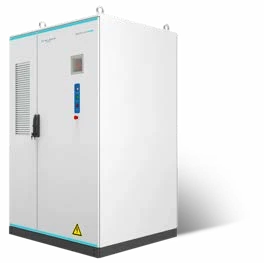
Its listed cabinet depth is 150mm less than AC418's, derived from 1500 − 1350mm. That does not establish a smaller complete installation: external inverter equipment, access and service clearances must also be accommodated. Compare a complete site layout, not just the cabinet outline. SOLVA technical brochure, p. 16; SOLVA technical brochure, p. 18.
Equal capacity does not establish equal delivered energy
For either model, applying the listed 90% depth of discharge gives 418kWh × 0.90 = 376.2kWh of arithmetic battery energy. Suppose an invented duty requires a constant 180kW AC load for two hours: 180kW × 2h = 360kWh. SOLVA technical brochure, p. 16; SOLVA technical brochure, p. 18.
Assuming zero conversion losses, no auxiliary consumption, no additional reserve and access to the full stated discharge window, 376.2kWh ÷ 180kW = 2.09 hours. This ideal calculation is not a two-hour performance commitment for either system. The 16.2kWh arithmetic margin above 360kWh is before losses, reserve and operating effects. Check the actual power capability and net AC energy of each complete design separately.
Use the same energy measurement boundary
Ask both proposals to state where delivered energy is assessed: at the battery, at the converter's AC output or at the agreed site connection. Request an explanation of the conversion and auxiliary allowances between those points. This prevents a battery-energy calculation in one proposal being compared with an estimate at the site connection in the other.
Keep the starting charge, reserve policy, load schedule and assessment period the same. If a supplier changes one of those assumptions, have the alternative shown separately. Any efficiency or delivered-energy estimate should identify its applicable equipment and operating conditions; a single percentage without those details is not enough to assess the proposed duty.
For a hypothetical expansion comparison, two cabinets of either model total 2 × 418 = 836kWh of stated battery capacity. Applying the listed 90% depth of discharge gives 836 × 0.90 = 752.4kWh of arithmetic battery energy, before losses and additional reserve. This does not establish the permitted configuration or delivered AC energy.
The identical energy arithmetic still leaves different conversion arrangements to assess. Ask how the proposed AC418 cabinets are coordinated, or how the DC418 cabinets connect to the selected external inverter arrangement. Neither the number of cabinets nor the total stored energy determines the complete system's available AC power.
Compare expansion and complete supply scope
AC418 supports up to 24 cabinets in on-grid parallel operation. DC418 supports up to 12 cabinets in DC parallel, requiring additional control and a point-of-connection cabinet; external inverters are connected in AC parallel. Those counts describe different arrangements and should not be compared as equivalent site limits. SOLVA technical brochure, p. 16; SOLVA technical brochure, p. 18.
- Request an equipment schedule covering cabinets, conversion equipment, transformers where applicable, controls and connection equipment.
- Define the same load duty, reserve policy and acceptance criteria for both proposals.
- Check delivery access, structural support, maintenance access and the planned expansion stage.
Resolve the interfaces before choosing a quotation
For AC418, ask who specifies the transformer and verifies the complete connection arrangement. For DC418, ask who confirms the external inverter combination and supplies the required control and connection equipment. For both, identify the party responsible for coordinating the cabinet, conversion equipment and site controls during commissioning.
Compare what the operator receives after installation. Request an agreed set of operating records, settings and commissioning results, together with a clear route for resolving an alarm that involves more than one component. Ask what happens if a component is unavailable for maintenance and which operating duty remains available under that condition.
Finally, have each supplier identify any unresolved assumption that could change the design or quotation. A useful recommendation explains why the proposed architecture fits the site's distribution and operating needs, and makes outstanding decisions visible. This provides a stronger basis for selection than comparing the two headline power figures alone.
Require any alternative transformer or inverter selection to be checked against the agreed site duty before accepting a substitution in the equipment schedule.
Explore the FWA storage range and retain the model pages from downloads. Request an AC418/DC418 architecture review with the site single-line diagram, distribution voltages and load data.
Frequently asked questions
Do AC418 and DC418 store the same amount of energy?
Both have 418kWh total capacity and 90% depth of discharge. Delivered AC energy depends on the complete system and operating assumptions. (SOLVA technical brochure, pp. 16 and 18.)
Is DC418 supplied with a 210kW inverter?
No. The 210kW rating applies to DC418’s integrated DC busbars. An external high-voltage central inverter must be selected and included separately in the project scope.
What AC voltage does AC418 provide?
Page 16 specifies 690V AC output, with three phases and protective earth and no neutral at that level. The site connection and transformer arrangement need engineering review.
Is the 215kW versus 210kW difference a fair performance comparison?
No. One figure rates AC418’s integrated PCS; the other rates DC418’s DC busbars. Compare the actual inverter, conversion path and operating limits of each complete proposal.