
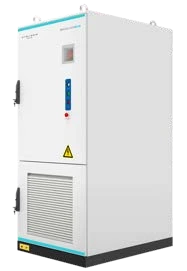
The Freedom Won SOLVA AC261 brings together 261kWh of lithium iron phosphate battery storage and an integrated 125kW power conversion system, or PCS. It is an AC-coupled option for commercial projects where the battery and its PCS are selected as one platform. Those two ratings answer different questions: kWh describes stored energy, while kW describes power. Both matter when assessing a proposed operating schedule. SOLVA technical brochure, p. 6.
What is included in the AC261 platform?
| Specification | SOLVA AC261 |
|---|---|
| Total battery energy | 261kWh |
| System depth of discharge | 90% |
| Integrated PCS rated power | 125kW |
| AC output | 400V; three-phase, neutral and protective earth |
| Dimensions, H × W × D | 2400 × 1050 × 1350mm, ±5mm |
| Cabinet weight | 2.7 tonnes |
Specifications: SOLVA technical brochure, p. 6. Total battery energy is not a promise of energy delivered to the site's AC loads.
Liquid heating and cooling manage battery temperature, while the cabinet management system interfaces with a site energy management system. Integration reduces the need to choose a separate battery PCS, while the project still needs a defined connection, control strategy and equipment schedule. SOLVA technical brochure, p. 6.
Translate the business objective into a load requirement
Start with the hours and equipment that matter. A request to support evening operation needs an energy profile across those hours. A request to limit grid demand needs the size and duration of the relevant peaks. A backup proposal needs a list of essential circuits, starting loads and the acceptable interruption for each process.
Record these as separate requirements. The same stored energy cannot be assumed available for both routine discharge and an untouched backup reserve at the same time. Ask the proposal to explain how priorities change with the battery's state of charge.
Measure demand where the battery will connect
Give the assessor the meter location as well as the data. Ask whether a file records grid imports, total site consumption or an individual circuit, and whether solar generation is recorded separately. The proposal should reconcile these measurements before assigning a battery duty. Include a typical working day, a busy day and a shutdown period so the chosen schedule reflects the business you intend to support.
Check the units and recording interval. In a hypothetical meter record, 12.5kWh consumed over 15 minutes represents an average of 12.5kWh ÷ 0.25h = 50kW. It does not establish the highest load during those minutes. Ask whether additional measurements are needed for motor starts or short peaks that matter to the proposed PCS duty.
For backup, identify which measured loads will actually be connected to the essential-load supply. A whole-site reading is a useful reference, but the proposal needs the selected circuits and their operating sequence.
A hypothetical sizing example
Assume a constant 50kW AC load is required for four hours. Its energy demand is 50kW × 4h = 200kWh. Using the AC261’s 261kWh total capacity and 90% depth of discharge gives an arithmetic battery-energy allowance of 261 × 0.90 = 234.9kWh. SOLVA technical brochure, p. 6.
Under an explicitly idealised assumption of zero conversion losses, no auxiliary consumption, no additional reserve and access to that full discharge window, 234.9kWh ÷ 50kW = 4.698 hours, approximately 4.70 hours. This is a calculation for an invented constant load, not an AC261 runtime claim. The 34.9kWh difference above the four-hour requirement must not be treated as confirmed spare AC energy.
A designer must account for operating limits, conversion losses, thermal-management consumption, starting state of charge, temperature, ageing and the chosen reserve. The load must also be checked against the PCS's applicable operating limits, including starting behaviour. An energy calculation alone does not establish backup capability.
Make the reserve policy visible in the calculation
Extend the four-hour example by assuming the business wants to retain an additional 30kWh of battery energy within the calculated discharge allowance. The energy assigned to routine operation becomes 234.9 − 30 = 204.9kWh. Compared with the invented 200kWh AC duty, that leaves an arithmetic difference of just 4.9kWh before conversion losses and auxiliary consumption. It therefore does not demonstrate that the duty and reserve can both be met.
The 30kWh reserve is an illustrative planning choice, not a recommended AC261 setting or a guaranteed amount at the AC terminals. Ask the designer to translate the agreed operating policy into settings and show how those settings affect daily dispatch. Also establish who may change them and what happens when an operator prioritises production over the usual reserve.
Request a schedule that follows charging, discharge and reserve through consecutive operating days. It should identify the assumed starting charge and the energy available to replenish the battery. This makes a proposal easier to assess when a busy evening is followed by another demanding shift.
Plan controls and expansion together
AC261 supports up to 24 cabinets in on-grid parallel operation or six in off-grid parallel operation, with an optional static transfer switch (STS). The design must establish the appropriate controls, switching equipment and permitted site connection for the proposed arrangement. SOLVA technical brochure, p. 6.
For backup, ask which switching equipment is included and how the essential-load arrangement will be tested. For an expansion proposal, ask whether the initial switchboard, cabling, controls and available space accommodate the intended later stage.
Agree what successful operation will look like
Specify the evidence you want at handover. For an evening operating duty, ask for records of power, delivered energy and reserve behaviour over the agreed period. For demand management, identify the measurement point and the demand threshold the controller is intended to address. For backup, agree a supervised test with the selected loads and record their response. Each test should state its starting conditions and acceptance criteria.
Include the normal operator in that discussion. Establish how they will see battery status, recognise a restricted operating condition and request support. Ask who reviews the controls when operating hours, solar equipment or production loads change. These responsibilities give the integrated cabinet a defined role in the business rather than leaving its daily operation implicit.
When comparing proposals, have each supplier identify any difference between the requested duty and the duty they have assessed. Resolve those differences before treating the prices as comparable.
Agree when the operating results will be reviewed against the original brief. Include a process for investigating a shortfall and approving any control change, with the reserve requirement kept visible.
Prepare a proposal that can be compared
- Supply interval electricity data, tariff details, operating hours and planned changes in production.
- Identify existing solar, inverter and generator equipment by exact model.
- Provide access information and ask the designer to verify the foundation, service clearances and cable route for the stated cabinet dimensions and weight.
- Request the proposed operating schedule, reserve settings, included equipment and commissioning acceptance criteria.
If your project calls for a separately selected inverter, compare the SOLVA DC261 integration approach. DC261 also has 261kWh of total energy, but uses 125kW DC busbars with an external inverter. Include that inverter in the scope when comparing it with AC261. SOLVA technical brochure, p. 11.
Review the commercial storage planning guide, explore the Freedom Won Australia storage range, and request an AC261 proposal with your load data and operating priorities. Keep the applicable brochure accessible through downloads when comparing proposals.
Frequently asked questions
Is SOLVA AC261 a 261kW battery?
No. AC261 has 261kWh of total battery energy and a 125kW integrated PCS. Energy capacity and power are different quantities. (SOLVA technical brochure, p. 6.)
Does AC261 include its power conversion system?
Yes. Page 6 identifies an integrated 125kW PCS. Ask the proposal to separately identify site switching, controls, cabling and any optional equipment.
Will one AC261 run a business for four hours?
That depends on the actual loads and operating conditions. The example assumes a constant 50kW load and ideal conversion; it does not establish delivered AC energy or guaranteed runtime.
Can AC261 support future expansion?
AC261 supports up to 24 cabinets on-grid or six off-grid in parallel. The project design must confirm the proposed arrangement, controls and connection capacity.