
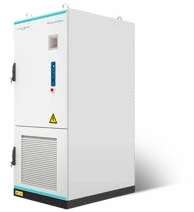
The SOLVA DC208 is a high-voltage DC-coupled battery cabinet with 208.8kWh of total energy capacity and integrated DC busbars rated for 100kW. It is designed for external inverter integration. The model's “208” label is a capacity-class shorthand; the detailed specification is 208.8kWh. Neither the model number nor the busbar rating specifies the AC output of a completed system. SOLVA technical brochure, p. 10.
For a commercial buyer, the useful question is whether this capacity and integration approach suit the required operating period. Begin with measured loads, then assess the external inverter and the complete installation.
The DC208 figures to use in a project brief
| Specification | SOLVA DC208 |
|---|---|
| Total energy capacity | 208.8kWh |
| System depth of discharge | 90% |
| Integrated DC busbars | Rated for 100kW |
| Nominal DC voltage | 665.6V |
| Dimensions, H × W × D | 2000 × 1050 × 1350mm, ±5mm |
| Weight | 2.3 tonnes |
Source: SOLVA technical brochure, p. 10. The listed nominal voltage is not a substitute for a confirmed operating-voltage window.
DC208 uses lithium iron phosphate cells, liquid heating and cooling, and CAN-bus communication with the external inverter. Select the inverter and firmware for the battery’s electrical limits and supported control requirements, so the two devices can operate as a coordinated system. SOLVA technical brochure, p. 10.
Define the operating period you are buying
Choose a specific duty for the first assessment: which equipment needs support, at what power and during which hours? Keep a normal operating day separate from an unusually busy day. Ask the assessor to show both cases rather than selecting a single average that conceals the more demanding period.
Provide meter data with its units, interval length and measurement location. Identify any solar generation or other equipment already affecting the recorded grid imports. For a backup requirement, map the selected circuits to the measurements so the capacity calculation represents the intended essential loads.
Explain how the business expects to grow. An additional operating hour and an additional machine create different questions for the energy and power assessment. Describe each planned change separately, including whether equipment runs together. This gives the designer a useful basis for comparing DC208 with another configuration.
Test energy demand before choosing cabinet numbers
Suppose an invented application needs a constant 30kW AC load for six hours. The load requires 30kW × 6h = 180kWh. Applying 90% depth of discharge to DC208’s 208.8kWh total capacity gives 208.8 × 0.90 = 187.92kWh of arithmetic battery energy. SOLVA technical brochure, p. 10.
That leaves only 187.92 − 180 = 7.92kWh between the calculated battery allowance and the requested AC energy, before losses or any extra reserve. Under ideal assumptions of zero losses, no auxiliary consumption and access to the whole stated discharge window, 187.92kWh ÷ 30kW = 6.264 hours, approximately 6.26 hours.
This calculation does not establish six hours of real AC service. Inverter conversion, auxiliary loads, operating limits, starting state of charge, temperature and ageing affect the result. A requirement that appears close on paper deserves a complete energy budget. Also check load peaks and starts separately: a six-hour energy total does not describe the instantaneous power requirement.
Test the duty and the charging opportunity together
Suppose the business can instead define an essential-load duty of 20kW for the same six hours. That hypothetical requirement is 20kW × 6h = 120kWh. The arithmetic difference from the earlier 187.92kWh battery allowance becomes 67.92kWh, before losses, additional reserve and operating effects. This is a different service requirement, not evidence that DC208 can meet the original 30kW duty for longer.
The useful buying question is whether the omitted equipment can genuinely remain outside the supported load. Identify who makes that operational decision and whether the proposed controls and switching implement it. A smaller essential-load schedule should reflect an agreed business priority rather than an unexplained reduction in the sizing spreadsheet.
Now consider replenishment. Assume, solely for illustration, that charging delivers a constant 25kW to the battery for four hours, with no further losses. That supplies 25kW × 4h = 100kWh. It would not replace the original 180kWh duty even under a loss-free comparison. This is an invented charging opportunity, not a DC208 charge-rate specification.
Ask the proposal to follow energy through repeated operating days, showing the charging source, available charging period and starting state of charge. A single discharge calculation does not establish a sustainable daily schedule.
How does DC208 compare with DC261?
DC261 has 261kWh, 125kW DC busbars and 832V nominal, compared with DC208's 208.8kWh, 100kW busbars and 665.6V nominal. Both use external inverter integration. SOLVA technical brochure, p. 10; SOLVA technical brochure, p. 11.
The total-energy difference is 261 − 208.8 = 52.2kWh; 52.2 ÷ 208.8 × 100 = 25% more total capacity for DC261. This arithmetic does not predict 25% longer AC runtime in two actual installations. Different inverter selections, operating settings and losses can change delivered energy. The different nominal voltages also mean the cabinets should not be treated as interchangeable in an inverter design.
Use the DC261 inverter integration guide to compare the approval questions, rather than choosing solely from the larger capacity figure.
Request the two model options against the same measured duty and reserve policy. Have the supplier identify whether the choice changes the inverter, connection equipment, installation layout or control settings. This makes any difference in price traceable to a complete scope, instead of attributing it solely to the additional stored energy.
Ask what evidence would change the selection: a longer measured operating period, a confirmed inverter limitation or a revised essential-load list. Those are useful decision points for a buyer who is still collecting site information. They also help distinguish a firm recommendation from a provisional shortlist.
Check the proposed installation and expansion path
- Inverter selection: request confirmation of the exact model, approved battery operating window, current limits, communications and firmware.
- Placement: have the designer verify delivery access, structural support, service clearances and cable routes using the stated dimensions and weight.
- Control: define charging windows, discharge priorities, reserve settings and the monitoring information needed by the operator.
- Expansion: ask which controller and connection equipment are included now and what a later stage would require.
DC208 supports up to 12 cabinets in DC parallel with an additional controller. External inverters can be connected in AC parallel as part of the system design. Plan storage and conversion capacity together, with the approved control and connection equipment included in the expansion scope. SOLVA technical brochure, p. 10.
At the site survey, walk through the cabinet's delivery route and proposed service area with the installer. Establish how the external inverter and connection equipment affect the layout, and ask for any access or support work to be included in the quotation. Cabinet dimensions alone do not describe the space required for the completed system.
For a staged purchase, agree the measurements that will trigger the next assessment and the operating requirement for that stage. Keep the initial duty clear even if future expansion remains undecided.
Make a model-specific enquiry
Explore the Freedom Won Australia storage range and inverter compatibility information. Then ask FWA about a DC208 configuration with your load data, required operating hours, existing equipment and proposed inverter. The commercial storage guide helps organise that brief; retain the applicable technical brochure from downloads.
Frequently asked questions
Is DC208 capacity 208kWh or 208.8kWh?
Use 208.8kWh for total capacity. That is the detailed specification on page 10; the model name uses a rounded capacity-class label.
Does the 100kW rating describe an included inverter?
No. Page 10 assigns 100kW to the integrated DC busbars. An external inverter is part of the proposed system design and needs its own specifications.
Can one DC208 supply a 30kW load for six hours?
The hypothetical calculation comes close before losses and reserve allowances. It does not prove six hours of AC operation; obtain a full energy and power assessment.
Which inverters can be paired with DC208?
Page 10 gives inverter examples, but the exact model, operating-voltage window, current limits, communications and firmware need confirmation. Do not infer compatibility across an entire brand.