
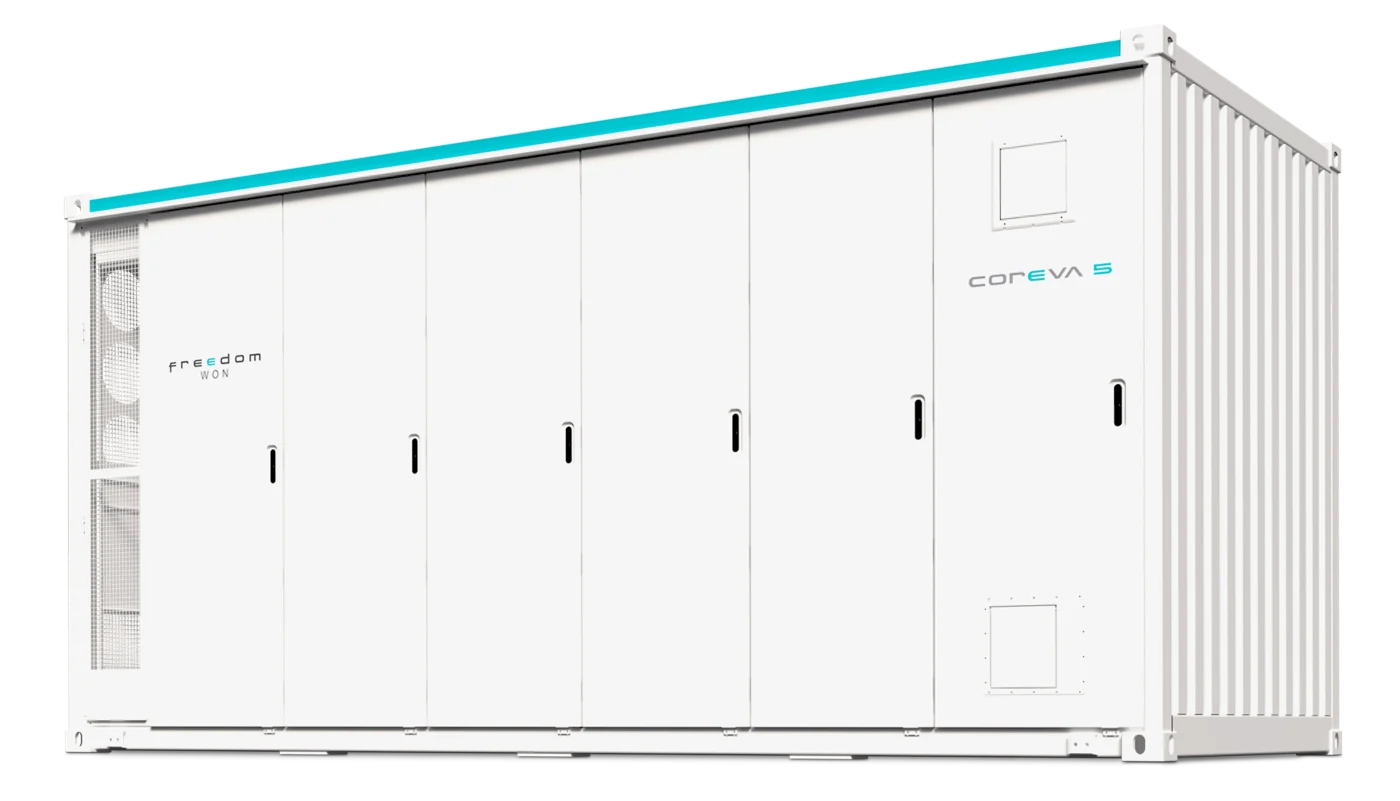
COREVA 5 brings battery storage to industrial projects at megawatt-hour scale, with 5,015kWh of energy capacity and a maximum output rating of 2,508kW. Use the facility’s load profile and operating objectives to determine the usable energy, sustained output and controls required from the complete installation. Source: FWA industrial product listing.
For a factory, processing facility or large commercial campus, the buying decision starts with the operating problem. Identify whether the priority is shifting solar energy into another shift, managing a defined demand period or supporting selected processes during an interruption. Each objective calls for a different operating brief.
Match capacity and output to the facility
| Specification | Value | What the proposal must establish |
|---|---|---|
| COREVA 5 energy capacity | 5,015kWh | Usable energy under the agreed operating limits |
| COREVA 5 maximum output power | 2,508kW | Permitted system output through the selected inverter and connection |
| Inverter arrangement | Project-specific | Exact model, quantity, ratings and control interfaces |
Product figures: FWA COREVA 5 listing. The final column is a procurement checklist, not an additional product specification.
Dividing 5,015kWh by 2,508kW gives approximately 2.00 hours. This is an illustrative ratio using the two public ratings, assuming all listed energy is available at constant listed power. It excludes reserve settings, conversion losses, auxiliary consumption and operating restrictions. It is not a warranted runtime or a statement that a proposed inverter can deliver that power.
Define the service at the site connection
A useful brief specifies where performance will be measured. Battery-side power, inverter output and net power at the site connection describe different boundaries. Ask the designer to state which boundary applies to every quoted rating and which loads or auxiliary systems sit inside it.
For demand management, provide interval data and identify the periods that create the problem. For backup, list the processes that must continue, their starting requirements and acceptable interruption. Ask for a separate explanation of islanded operation if it is required; do not assume a storage capacity figure establishes that capability.
Turn the production schedule into a dispatch brief
Consider a hypothetical factory seeking to reduce grid demand by 500kW for two hours during an afternoon production period. The requested contribution is 500 × 2 = 1,000kWh at the chosen measurement boundary. That describes the task; it does not select a battery or establish how much nominal capacity must be purchased. The proposal still needs to allow for the relevant losses, reserves and equipment limits.
Now ask what happens if production overruns, solar generation is lower than forecast or the battery starts partly charged. Have the modeller show which objective takes priority when the available energy cannot satisfy every request. A reserve intended for essential processes should be identified separately from energy allocated to routine demand management.
Include planned shutdowns and restart periods in that discussion. The important comparison is how each proposed configuration meets the same operating brief across those scenarios. Ask for the remaining grid demand and any unmet requirement to be visible, alongside the battery contribution, rather than receiving only a favourable average-day illustration.
Resolve the inverter identity before procurement
A COREVA 5 proposal should identify the exact external inverter and its applicable datasheet. Confirm the conversion equipment, model, quantity and control interfaces in the equipment schedule so the battery and inverter are assessed as one complete installation.
Request a matched battery-and-inverter equipment schedule, document revisions and a single-line diagram. The schedule should distinguish component ratings from the approved operating limits of the assembled system. Our battery and inverter compatibility guide explains the evidence to request.
Compare complete proposals on the same basis
Where a smaller or staged installation is being considered, compare the architecture as well as capacity. SOLVA AC models include a power conversion system, while DC models use an external inverter. That distinction changes the equipment scope and connection design. Compare each complete installation against the same load, duration and operating requirements. Source: SOLVA technical brochure, range overview.
Use the SOLVA configuration guide to frame that comparison. Require each proposal to include the same installation boundary, control functions, service scope and acceptance criteria before comparing the totals.
Make scope differences visible before comparing prices
Divide the proposal into equipment supply, site works, electrical connection, controls, commissioning and ongoing support. For each part, name the responsible party and identify any allowance that will be revised after investigation. This helps a procurement team understand whether two offers cover the same work and where the final cost remains uncertain.
Ask how existing operations will be affected during installation. Delivery arrangements, available working space and planned electrical shutdowns should be discussed with the facility team before the installation programme is accepted. A proposal can then distinguish decisions needed before ordering from details that can be finalised during engineering.
Confirm who will configure the initial operating schedule and assess later changes. If production moves to different hours, the facility should know how to request a review and who can authorise revised controls. Include operator training and post-commissioning support in the scope so responsibility continues beyond the initial equipment handover.
For financial assessment, request the assumptions separately from the result. Identify the load dataset, tariff period, charging strategy, operating costs and any forecast changes in production. Ask the modeller to vary the assumptions that matter most to the facility and explain what drives the difference. This gives the buyer a basis for evaluating the business case without treating a single forecast as a promised saving.
Build a decision-ready project brief
- Supply interval load data, operating calendars and planned production changes.
- Identify existing solar, generators, transformers and connection constraints.
- Define energy-shifting and backup priorities separately, including any reserve requirement.
- Provide a site layout with delivery access, equipment space and service access.
- Request an operating model showing assumptions, limitations and any excluded work.
Agree how the service will be measured
Define the evidence for success before selecting equipment. If the objective is reducing demand during a production window, agree which meter records that demand and how the comparison will account for changes in output or operating hours. If the objective is stored solar, ask how charging energy and later delivery to the site will be distinguished in the monitoring records.
A commissioning demonstration and an operating review answer different questions. The demonstration should show the functions included in the approved scope under the agreed test conditions. The later review should assess whether the control strategy is meeting the facility's needs through representative operating periods. Record who will review the data and who can authorise a settings change.
Request a clear explanation of exceptions, including incomplete data, maintenance periods and changes to the load. This makes a performance report useful to both engineering and finance teams. It also creates a documented starting point for discussing future capacity or control changes when the factory's requirements evolve.
At handover, ask for the approved drawings, settings record, monitoring access, maintenance responsibilities and agreed functional checks. These deliverables make the proposed operating strategy understandable to the team that will run the facility.
Discuss a COREVA 5 project with Freedom Won Australia using this brief. Request current model documentation and a proposal that connects the selected industrial storage equipment to measurable site requirements.
Frequently asked questions
What capacity is publicly listed for COREVA 5?
COREVA 5 has 5,015kWh of energy capacity and 2,508kW maximum output power. Confirm the usable energy and system output in the approved design.
Does COREVA 5 provide two hours of backup?
The public energy-to-power ratio is approximately two hours under idealised assumptions. Actual backup duration needs a defined load profile, usable-energy allowance, losses, reserves and inverter limits.
Which inverter should a COREVA 5 proposal specify?
The proposal must identify the exact inverter and supporting documents. The CAB100/CAB1000 naming discrepancy in FWA's public materials needs resolution before procurement.