
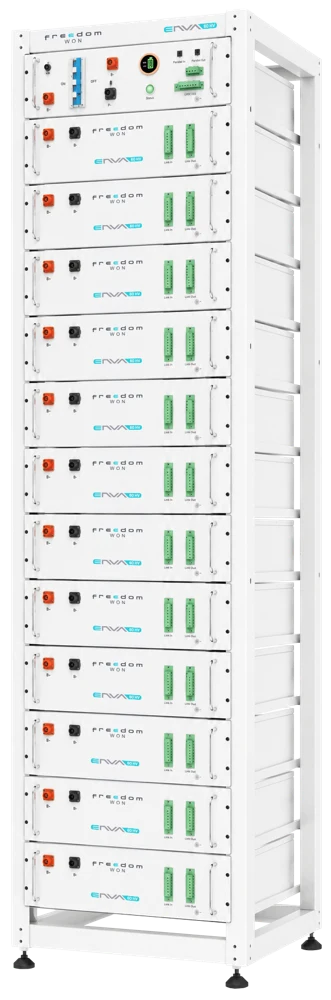
Commercial battery selection starts with the operations you want to support. A site may need stored solar for evening activity, a defined period of essential-load backup, or both. ENVA HV should be assessed against those requirements with the inverter, controls and charging arrangement identified from the outset.
The standard 12-module ENVA 60HV configuration provides 61.44kWh of rated battery energy. Its maximum power rating is 69kW; continuous delivery to the site also depends on battery operating limits, inverter capacity and the selected configuration. Assess these together when planning the load and operating schedule. FWA listing; manufacturer specification sheet.
Separate the battery configuration from the site design
| Reference | Value | How to use it |
|---|---|---|
| FWA maximum-output listing | 69 kW | Headline maximum; not a continuous AC system rating |
| Manufacturer rated energy | 61.44 kWh | Standard 12-module configuration |
| Manufacturer nominal voltage | 614.4 V | Input for exact inverter matching |
Sources: FWA product page and ENVA 60HV sheet, internally dated 16 September 2026. The latter specifies maximum-current duration of five minutes per 30 minutes and temperature derating. It does not give 69 kW as a continuous AC rating.
The practical implication is straightforward: ask the designer to state the available continuous output at the nominated circuits. The battery's voltage, current limits and operating conditions must be considered alongside the selected inverter and controls.
Where loads operate across several circuits or phases, ask the designer to show how the nominated equipment is distributed. A site-wide total can conceal the way demand falls on the proposed inverter arrangement. The proposal should explain that allocation alongside the total energy budget.
Calculate the energy consequence of your backup scope
Here is an original planning example with constant assumed loads, no solar contribution and no other supply during a three-hour outage. These are hypothetical requirements, not measured commercial loads or predicted ENVA HV performance.
| Assumed scope | Power | Duration | Required energy at loads |
|---|---|---|---|
| Essential operations | 12 kW | 3 hours | 36 kWh |
| Broader site operation | 28 kW | 3 hours | 84 kWh |
Energy equals power multiplied by time: 12 × 3 = 36 kWh, while 28 × 3 = 84 kWh. The broader scope exceeds one standard configuration's 61.44 kWh rated energy even before losses and reserve. The essential-load case still needs a full design assessment; being below rated capacity does not prove that it is achievable.
This exercise helps decide which processes matter most. Separate loads that must operate throughout an interruption from those that can stop, restart later or run for a shorter period. Capture starting demand and the consequences of interruption as part of that discussion.
Translate essential operations into stages
An essential-load brief can include different operating stages. Extend the hypothetical example by assuming that the site needs 12 kW during the first hour, then can operate selected processes at a combined 8 kW for the following two hours. With no solar or other supply contribution, the load energy becomes 12 × 1 + 8 × 2 = 28 kWh, compared with 36 kWh for a constant 12 kW over three hours.
This revised schedule reduces the energy target by 8 kWh while retaining the initial 12 kW running requirement. It does not establish that ENVA HV can deliver the schedule. Battery operating limits, conversion, available charge, starting demand and the selected inverter still require assessment.
Before using such a schedule, have the people responsible for operations identify which processes can change and when. Ask whether any equipment must complete a cycle before stopping, whether restarting adds another demand, and who would control the transition. Those answers determine whether the staged scenario is a credible design case for that business.
Specify the integration and operating sequence
Prepare a short operating brief describing what should happen during ordinary daytime operation, after sunset and during an outage. If solar or a generator is already installed, provide the equipment details and ask how it participates in the proposed sequence.
Ask for a sequence that can be checked
For each operating mode, ask the designer to describe the starting condition, the event that changes the mode and the loads that remain supplied. A daytime interruption with substantial charge available is a different assessment from an interruption near the end of the evening operating period. Have both considered if both matter to the business.
If solar or a generator forms part of the proposed arrangement, ask what is expected to happen when that source becomes available or unavailable. Identify who is responsible for coordinating the equipment and what the operator will see. These are questions for the proposed system; they do not assume that ENVA HV alone provides any particular switching or control function.
Agree which assumptions the commissioning demonstration should check. Examples include the nominated circuit allocation, the reserve strategy and the response to the operating events in the brief. Ask how any difference between the design and the completed configuration will be documented for the people who operate the site.
- Identify essential circuits and their phase arrangement, sustained loads and starting demand.
- State the period of support to be assessed and the assumed starting state of charge.
- Define charging opportunities and the energy held back for an unplanned interruption.
- Ask how controls handle competing daily-use and backup priorities.
- Provide site drawings, access information and the proposed equipment location.
Use FWA's inverter compatibility information to begin an exact model review. High voltage is a battery-platform characteristic; it does not by itself establish suitability for your site's phase arrangement or existing inverter.
Assess the plant room and the delivery scope
Give FWA enough site information to assess the proposed arrangement beyond its electrical ratings. Photographs should show the intended equipment position, access route and surrounding equipment. Provide available drawings and identify restrictions on delivery or work periods. Ask the designer which further measurements are needed for the actual configuration, rather than assuming that a product footprint describes all the space required.
For an operating business, discuss whether installation and commissioning need to fit around trading, production or other scheduled activity. Identify any processes that cannot be interrupted during those periods. The assessment can then address the practical work sequence as well as the eventual battery operating sequence.
Request a clear description of the supplied battery configuration, inverter, controls and integration work. Ask which drawings, equipment records and operating instructions will be handed over. This makes it easier to compare a complete ENVA HV proposal with an alternative configuration and to understand who will resolve questions about the combined system after installation.
Resolve document versions before final selection
The Australian downloads link and the newer manufacturer sheet differ on permitted discharge depth and parallel-bank count. Have FWA confirm the applicable specification and configuration in writing. Those differences affect design assumptions and should be resolved before a multi-bank proposal is accepted. FWA-linked May 2026 sheet; manufacturer September 2026 sheet.
For the wider project brief, use the commercial storage guide. If another commercial system architecture is under consideration, the SOLVA AC, DC and RT guide provides the next comparison. The battery sizing guide explains the underlying units.
Discuss ENVA HV with Freedom Won Australia and bring your interval data, essential-load schedule and existing equipment list. Request the applicable documents through downloads and ask for the proposed operating sequence to accompany the configuration.
Frequently asked questions
Are ENVA HV and ENVA 60HV the same product label?
ENVA HV is the high-voltage product family. ENVA 60HV is its standard 12-module configuration, rated at 61.44kWh. Confirm the exact module arrangement in your proposal.
Does the 69 kW listing mean continuous backup at 69 kW?
No. The 69kW figure is a maximum rating. Sustained AC output depends on battery current and duration limits, temperature, inverter capacity and the system configuration.
Can one ENVA HV system support my entire business?
Define the circuits, simultaneous demand and duration first. Whole-site support and selected essential-load support can require substantially different designs, even at the same premises.
Can ENVA HV banks be added in parallel?
The reviewed sheets describe parallel configurations but differ on the bank-count limit. Ask FWA to confirm the applicable revision and approved arrangement for your project.