
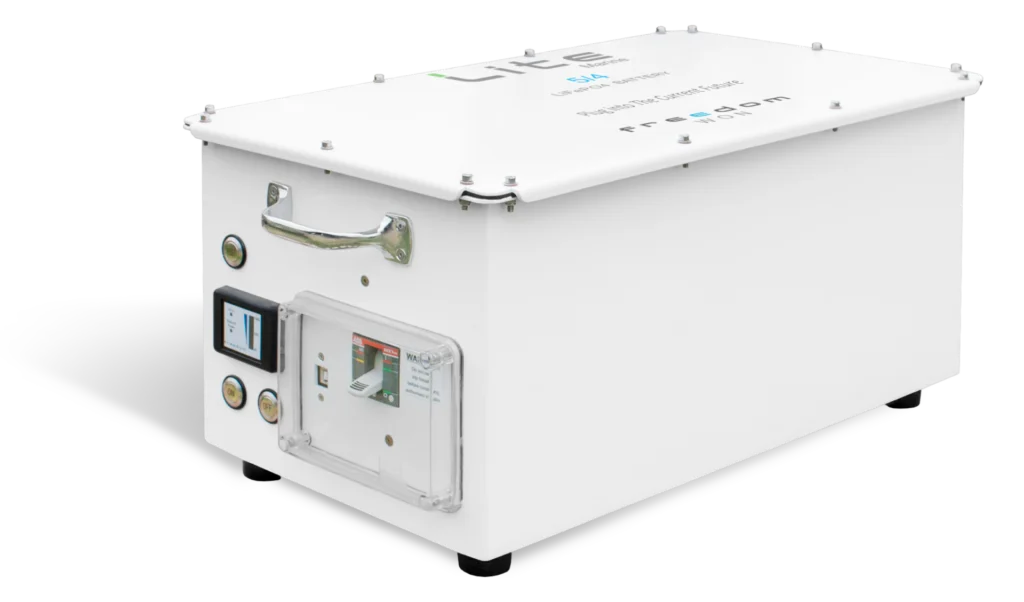
A marine battery refit starts with the vessel's electrical architecture. The battery must suit the equipment being retained, the loads it will support and the available charging sources. The LiTE 2 Marine range comprises four models: 5/4, 10/8, 20/16 and 30/24. Use those full names when requesting a replacement or comparing a new installation. Source: FWA marine product listing.
Compare energy capacity and operating voltage together. Confirm the exact variant, availability and applicable documentation with FWA before ordering, particularly where an existing battery's nameplate differs from a website description.
Compare all four LiTE2 marine models
| Model | Total energy | Energy at 80% depth of discharge | Published nominal-voltage entries |
|---|---|---|---|
| LiTE 2 Marine 5/4 | 5kWh | 4kWh | 13V, 26V and 52V |
| LiTE 2 Marine 10/8 | 10kWh | 8kWh | 13V, 26V and 52V |
| LiTE 2 Marine 20/16 | 20kWh | 16kWh | 13V, 26V and 52V |
| LiTE 2 Marine 30/24 | 30kWh | 24kWh | 26V and 52V have populated specification entries; 13V requires clarification |
Sources: linked manufacturer model sheets, each dated 12 March 2025. The 30/24 sheet lists all three voltages in a general row, but marks the third variant's operating-voltage, current and inverter entries N/A. This table does not confirm a 13V 30/24 variant.
The second number in each model name corresponds to the listed energy at 80% depth of discharge. It is not a promise of energy delivered to onboard appliances: reserve settings, conversion losses and the selected operating limits still need to be considered.
Size for the period between charging opportunities
Record what runs at anchor, overnight and underway, and distinguish continuous loads from occasional equipment. Include charging opportunities from shore power, solar, a generator or an alternator where fitted. The useful question is how much energy the vessel needs before the next dependable recharge.
For illustration only, a constant 400W load over ten hours consumes 0.4kW × 10h = 4kWh. This is a hypothetical load calculation, not an estimate for a particular vessel or battery. Although 4kWh matches the 5/4 sheet's 80%-discharge energy figure, that comparison leaves no allowance for conversion losses, reserves or additional loads. It is a reason to investigate further, not a sizing recommendation.
Compare an overnight stop with a longer stay
Extend the same hypothetical 400W average load to twenty hours without charging and the demand becomes 0.4 × 20 = 8kWh. Doubling the period doubles the energy requirement under that constant-load assumption. It does not establish that a particular model will cover the stay, because the calculation still excludes the allowances described above.
For your vessel, build separate schedules for a normal overnight stop and the longest intended period between dependable charging opportunities. Record the assumed operating time of each appliance and flag estimates that need measurement. Equipment that cycles on and off should be represented by an assessed average demand over the relevant period, with simultaneous and starting requirements reviewed separately.
This also makes the comparison between capacities more useful. Ask what operating requirement each shortlisted model would satisfy under the same assumptions. If a larger model is proposed, have the supplier explain whether the additional energy addresses a longer stay, a larger reserve or a planned increase in loads. Avoid paying for capacity without a clear purpose.
Match the exact voltage and charging arrangement
Keep the battery's published 13V, 26V or 52V designation in the equipment schedule. A familiar voltage-class description does not replace checking the actual operating range against the inverter and every charging source.
Ask the installer to document charge control, battery-management communications and the response when the battery requests charging to stop. Also record which equipment will be retained and which interfaces need to change. The battery and inverter compatibility guide provides a structured request for those details.
Map every charging opportunity
List the charging sources expected to be available in each operating situation. A vessel connected to shore power has a different planning brief from one relying on equipment available while underway or at anchor. For every source, identify its model, control arrangement and the period during which it can realistically be used.
Ask the designer to show how charging and onboard consumption are accounted for together. A charging opportunity may coincide with substantial appliance use, so the proposal should explain the energy available to restore the battery after serving those loads. If more than one source can operate, request confirmation of how their combined contribution is controlled within the selected battery's documented limits.
Include the expected response to an unavailable source in the operating discussion. Which activities would be deferred, when would another charging opportunity be sought, and what information would the crew use to decide? These are operating choices to agree for the vessel, rather than settings that can be inferred from a battery capacity label.
Check location, access and installation requirements
LiTE2 Marine batteries belong in protected below-deck locations, away from saltwater spray. Have the installer assess the proposed position, access and environmental conditions against the requirements for the selected model. Source: LiTE 2 Marine installation-location note.
- Confirm the selected unit's dimensions and weight against the installation space and access route.
- Have mounting, cable routing and protection included in the installation design.
- Request the applicable installation manual, warranty and model-specific operating limits.
- Agree how the crew will view battery status and respond to an alarm.
Scope the refit around access and future servicing
Measure the route into the battery compartment as well as the final mounting position. Ask how the selected unit will be moved, secured and later removed for service. Include nearby equipment, access panels and the space required to reach connections in the layout review.
For an existing installation, assemble photographs of the battery nameplate, chargers, inverter and compartment before requesting a proposal. Identify any equipment that must remain in service during the refit and agree when the vessel can be unavailable. These details allow the installer to describe the work sequence and identify investigations needed before ordering.
Ask for a handover that suits the people operating the vessel. It should identify the installed equipment, monitoring arrangements and support contact, together with the procedures approved for that installation. A future owner or technician should be able to establish what was fitted without reconstructing the refit from product names alone.
Compare LiTE2 with the separate new marine range
The new IP66 marine range comprises 52V 10/8kWh, 52V 16/13kWh and 96V 30kWh models. Compare their voltage, current, enclosure and connectivity features with the LiTE2 option suited to your vessel. Similar capacity labels do not make different generations interchangeable. Source: new marine flyer.
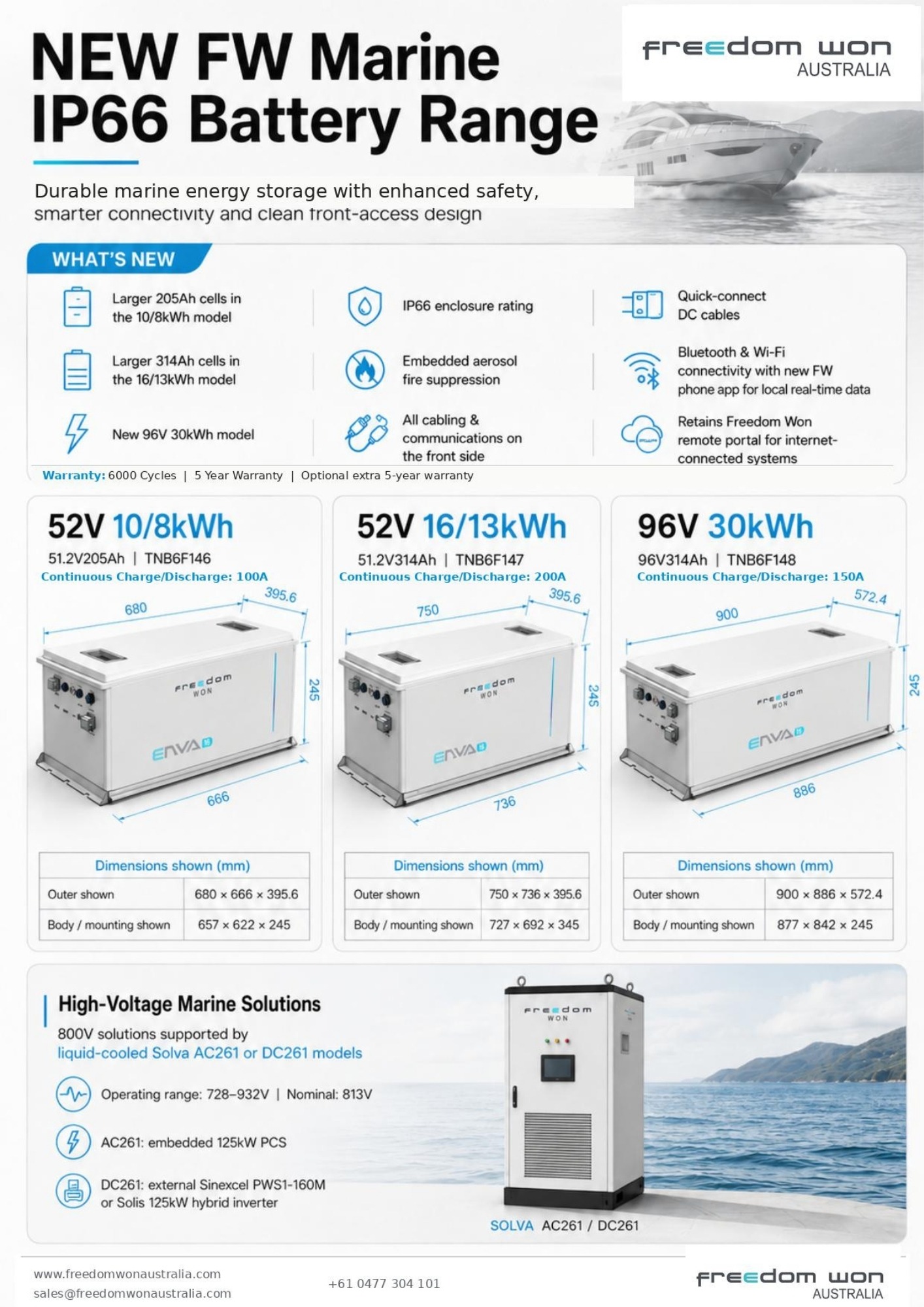
Compare quotations using the complete refit scope. If an option changes the battery voltage or equipment arrangement, ask which existing components can remain and which require replacement or reassessment. Include installation labour, interfaces, monitoring and commissioning when reviewing the difference.
Keep the reasons for the selection in the proposal: the intended operating period, charging plan, installation constraints and confirmed model documentation. That record gives FWA and the installer a clear basis for reviewing an alternative if availability changes before purchase, without assuming that a similarly named product is a direct substitute.
Read the new marine battery range guide, then send FWA your vessel's load schedule, battery nameplate and charger details. Ask which marine battery option fits the refit and obtain its documents through the download centre.
Frequently asked questions
What are the four LiTE2 marine models?
The range includes LiTE 2 Marine 5/4, 10/8, 20/16 and 30/24. Their total energy capacities are 5, 10, 20 and 30kWh respectively.
Is LiTE 2 Marine 30/24 verified in a 13V version?
The reviewed sheet is internally inconsistent: its general voltage row includes 13V, while relevant third-variant entries say N/A. Obtain written clarification of the exact variant before specifying it.
Can I select an inverter from the battery's energy capacity?
No. Capacity alone does not establish voltage compatibility, continuous power, transient capability or communications. Request a documented match for the exact battery and inverter.
Does the new marine range replace these specifications?
The new IP66 models form a separate range with their own voltage, current and installation requirements. Confirm the model code and availability, then assess the unit against the vessel’s electrical system before ordering.