
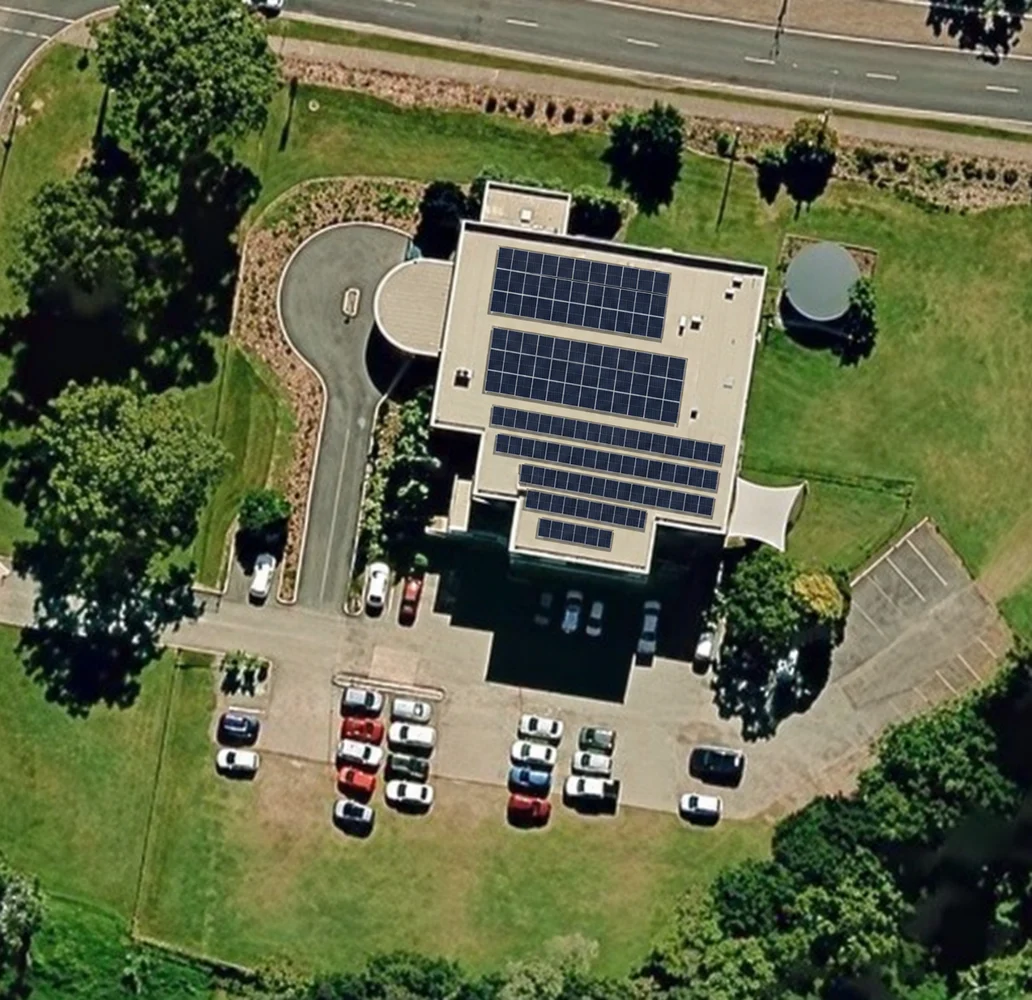
Community venues often need electricity after their solar production has fallen away. At Unity Hub in Slacks Creek, Queensland, battery storage makes daytime solar available for evening events and other activities outside solar hours. A raised battery platform also addresses the power room’s history of flooding. Source: Unity Hub project sheet.
For a venue committee or facilities manager, the project offers two practical starting points: match storage to the event calendar, and assess where the equipment can be installed and maintained.
Image: rooftop solar layout visualisation. The raised battery system image is also a design visualisation, not an installation photograph. Source: project image captions.
The system at Unity Hub
| Element | Project figure | Role described in the sheet |
|---|---|---|
| Rooftop solar | 60kW | Daytime generation for use and storage |
| Freedom Won HV batteries | 180kWh | Six 30kWh batteries |
| Three-phase inverters | Three × 20kW; 60kW total | System power conversion |
| Grid protection panel | 125A | System bypass switch included |
Source: Unity Hub, Slacks Creek reference project. Equipment capacity and power ratings.
The two 60kW figures describe different equipment: solar generation capacity and total inverter capacity. The 180kWh figure describes stored energy. None of those ratings alone establishes the amount of energy available for a particular event.
Build the brief around evening activities
For a similar venue, collect event start and finish times, preparation and cleaning periods, attendance patterns and the equipment used. Separate regular activities from occasional large functions. A calendar can reveal whether energy is needed every evening or concentrated on a few busy days.
Ask for interval consumption data that covers representative events. Include daytime demand because solar used during the day is not simultaneously available for battery charging. The design assessment should show both the evening requirement and the energy expected to be available beforehand.
For illustration only, an event averaging 30kW for four hours would consume 120kWh: 30 × 4 = 120. This hypothetical energy budget is not a measured Unity Hub load. Comparing it with 180kWh of listed storage does not prove the event can be supplied: starting charge, usable-energy limits, losses, reserves and simultaneous loads still need assessment.
Assess a week of activities as well as a single event
Extend the hypothetical example to two identical events on successive evenings: each requires 120kWh, so their combined load energy is 240kWh before any storage-related allowances. That total does not mean the venue needs a 240kWh battery. The assessment must account for charging between events, starting battery state and other site consumption. It also cannot establish what Unity Hub actually uses.
Compare that pattern with several events on the same day or a weekend following a quiet week. Ask the modeller to show how the battery state changes through the sequence, including preparation, pack-down and ordinary building use. Identify any event that depends on a favourable starting condition.
This gives the committee a practical way to discuss priorities. Is the main objective supporting regular evening activities, accommodating occasional larger functions or maintaining a reserve for specified needs? Record the answer in the brief and ask suppliers to explain how their operating strategy addresses it.
Make equipment placement part of the project
The raised platform positions the batteries above the previous flood line. For another flood-prone site, assess the design level, electrical equipment, access and recovery arrangements against its own flood risk. A previous flood level alone does not define protection from future events. Source: flood-risk design description.
For another facility, ask the project team to establish the relevant site conditions and proposed installation level. Include access for service, equipment delivery and any structural work in the scope. Also ask how associated equipment and connections are addressed; battery elevation is one part of the installation discussion.
Turn the site visit into a complete installation scope
Provide the project team with available site plans, information about previous flooding and photographs of the proposed equipment location. Ask which details need professional investigation before the design is finalised. Record who is responsible for the platform, electrical work and any changes to access or the surrounding space.
Discuss how installation and later servicing will fit around venue bookings. Identify any periods when rooms, access routes or electrical supplies may be unavailable and agree how the venue will communicate those constraints to its users. Include reinstatement and handover responsibilities in the proposal.
Where a design choice remains open, request its effect on the scope and programme. This allows the committee to make a specific decision rather than approving an equipment price while leaving significant site work undefined.
Give the committee a clear comparison
- Energy objective: identify which evening activities storage is intended to support.
- Operating evidence: request event and non-event load profiles with stated solar assumptions.
- Project scope: distinguish equipment, platform works, electrical integration and commissioning.
- Continuity: define any required backup function separately and confirm which circuits it would cover.
- Ownership: assign monitoring, alarm response, maintenance and access responsibilities.
Ask each supplier to present the same representative booking scenarios, including a normal evening and the busiest proposed sequence. Keep the assumed opening hours, loads and starting conditions consistent. If one offer depends on shifting an activity or maintaining a different reserve, make that dependency visible to the committee.
Clarify which decisions belong to the venue and which require technical assessment. Staff can describe how activities are scheduled and which services matter most; the project team must assess the equipment and design needed to support those priorities. Documenting both responsibilities helps the venue review an offer without relying on a capacity figure as a substitute for an operating plan.
When comparing proposals, give each supplier the same operating brief. Ask for the assumptions behind any estimate of reduced grid purchases and identify costs that sit outside the equipment package. This helps a committee understand what it is approving and which decisions remain open.
Measure results against the venue’s needs
The system is intended to use stored solar for evening activities and reduce grid purchases. To quantify that benefit, compare event schedules, battery delivery, grid imports and tariffs over a defined period. A payback assessment also needs the installation costs and operating expenses. Source: stated operating purpose.
Measure evening use in context
Agree what information the committee wants to review after commissioning. Useful questions include how much energy the venue used during events, how battery charging and discharge aligned with those activities, and how grid purchases varied with the booking calendar. Identify the available meters and monitoring records before deciding how those questions will be answered.
Keep a record of changes in attendance, event duration and equipment use alongside the energy data. Compare representative periods and explain missing readings or unusual activities. An apparent change in consumption should be interpreted with those operating differences in view.
Nominate a person to maintain the records and arrange a review with the project team. The review can then identify whether the agreed strategy needs adjustment or whether changed venue requirements warrant further assessment. Those records give the committee a practical basis for adjusting the operating strategy or assessing future expansion.
Use the commercial storage planning guide to prepare a brief and the integration checklist to review the equipment scope. Discuss your community venue with FWA, including its event calendar and site layout, to assess suitable commercial battery storage. Retain the project sheet and selected model documents through downloads.
Frequently asked questions
How much storage and solar does Unity Hub have?
Unity Hub has 180kWh of Freedom Won high-voltage storage, 60kW of rooftop solar and three 20kW three-phase inverters, giving 60kW of total inverter capacity.
Are the Unity Hub images installation photographs?
No. The rooftop solar layout and raised battery system images are design visualisations, as labelled in the case study.
Does this community battery supply surrounding households?
This installation serves Unity Hub’s events and other venue activities. It is not presented as a household subscription or neighbourhood energy-sharing service.
Does the raised platform guarantee flood protection?
The batteries are positioned above the previous flood line. Future flood protection depends on site-specific design conditions and requires its own assessment.