
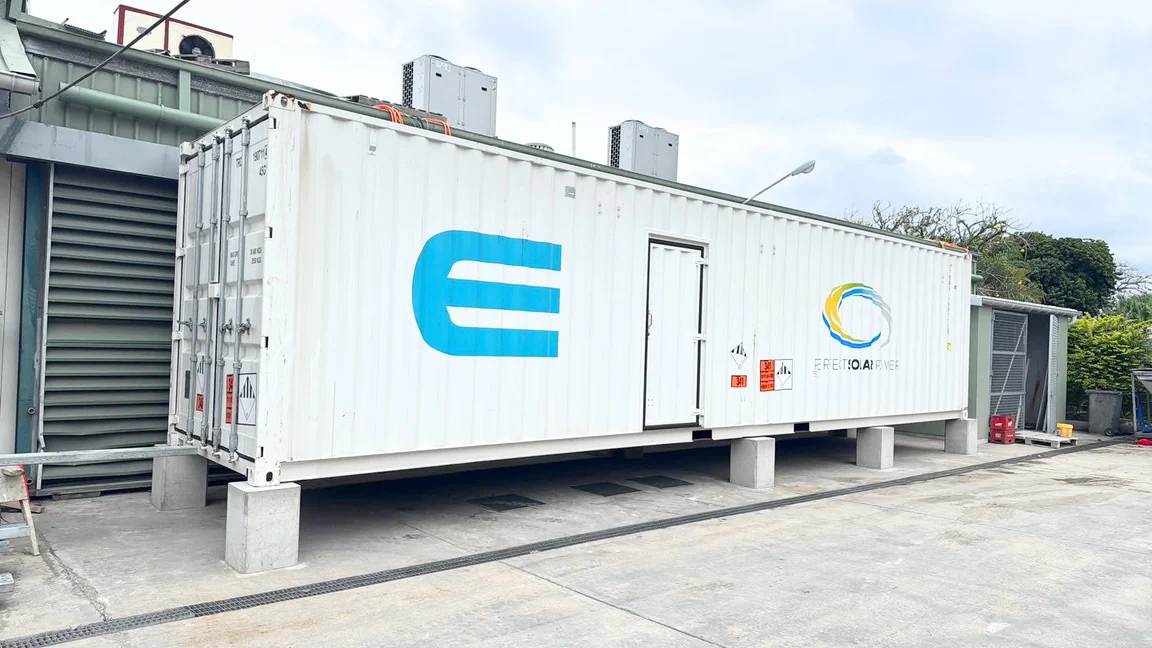
LCM Store in Santo, Vanuatu, combines commercial battery storage with solar and generator backup in one coordinated power system. The installation includes 885kWh of megaTower battery storage, 150kW total hybrid inverter capacity and integration of solar, controls and generator backup within a 12m containerised Power Room. Source: LCM Store project sheet.
The commercial lesson is the relationship between today's equipment and tomorrow's needs. A project brief should explain how generation, storage and backup work together now, then identify the infrastructure and additional equipment required for a later stage.
Inside the LCM Store system
| Element | Installed system and expansion provision |
|---|---|
| Battery storage | 885kWh Freedom Won megaTower |
| Hybrid inverter capacity | 150kW total |
| Solar integration | AC- and DC-coupled solar |
| Backup | Generator integrated into system controls |
| Power Room | 12m containerised arrangement |
| Future storage | Provision for approximately 1.77MWh |
All project figures and integration details: LCM Store, Santo reference project, pages 1–2.
The 150kW figure is the total hybrid inverter capacity, not a rating to multiply by an assumed inverter count. Likewise, the sheet gives aggregate storage capacity without establishing a battery unit count. Equipment quantities belong in the approved schedule.
Understand the operating sequence
The system prioritises renewable energy: solar serves the business during daylight, excess energy is stored, and the generator provides backup when solar and battery energy are insufficient. Integrated energy-management controls coordinate these sources and the site loads. Source: documented system functions.
For another business, translate that sequence into questions about its trading pattern. When does demand begin relative to solar generation? Which loads continue after closing? Are there short periods when several large loads overlap? These answers help the designer distinguish an energy requirement from a power requirement.
Ask for the proposed control priorities in writing. For example, clarify whether stored energy is reserved for particular operating periods and how the system handles a low-solar day. Those are requirements to establish for your site, rather than settings that can be inferred from this reference project.
Test trading-day and overnight requirements separately
A hypothetical store might need 40kW for three hours after solar generation falls away, giving an energy requirement of 120kWh. Another operating period could require 80kW for one and a half hours, also 120kWh. These invented examples have equal energy requirements but different power demands. They are not LCM operating measurements and do not predict the performance of its installation.
Use that distinction when assembling your own load evidence. Identify the overnight base load, the equipment used before opening and the combinations that operate during busy trading periods. Ask whether planned extensions to opening hours change the energy requirement, the maximum simultaneous demand or both.
Request a separate operating illustration for quiet days when daytime consumption may differ. The designer should explain how the proposed controls respond to those variations and what remains available for the next trading period. This discussion connects the equipment schedule to the business calendar without assuming every day follows the same pattern.
Separate future provision from installed capacity
The installation includes infrastructure provision for increasing storage from 885kWh to approximately 1.77MWh. Converting units gives 1.77MWh = 1,770kWh; 1,770 ÷ 885 = 2. The stated future target is therefore approximately twice the initial installed capacity. This arithmetic compares capacity totals only. It does not establish battery counts, present installed capacity beyond 885kWh, or a doubling of inverter output. Source: expansion provision.
For a staged procurement, request separate schedules for equipment installed now, infrastructure allowed for now and equipment purchased later. Ask which mechanical, electrical and control changes the later stage would need. “Expandable” becomes useful when the scope and remaining work are visible.
Define the trigger for a second stage
Before committing to an expansion allowance, identify what would justify using it. Examples for assessment include longer trading hours, additional equipment or a revised requirement for energy outside solar hours. Ask the supplier to show which change would call for more stored energy and which would require a review of power conversion or generation.
Request an expansion drawing that identifies the space and interfaces reserved in the first stage, together with a description of the work still required. The later equipment should have its own compatibility and design review when it is selected. An allowance made today does not, by itself, confirm every future component or operating mode.
Also discuss the installation sequence for that later work. Who would assess the existing system, arrange access and recommission the expanded configuration? How would the business maintain its required supply during the change? Recording those responsibilities gives the expansion provision a practical meaning beyond a future capacity figure.
What to take into a similar proposal
- Load evidence: provide trading hours, interval data and planned changes to refrigeration, processing or other equipment.
- Existing generation: identify solar equipment and generator specifications, including what must be retained.
- Integration scope: ask who supplies controls, switching equipment, communications and commissioning.
- Expansion boundary: distinguish physical space from confirmed electrical and control provisions.
- Operational ownership: identify who receives alarms, reviews performance and arranges service.
A supplier comparison should use the same requirements for each proposal. A lower equipment price is difficult to evaluate if one offer includes integration and commissioning while another leaves them outside the scope.
Assess the Power Room as part of the site
For a containerised proposal, ask for the delivery and placement requirements early enough to include them in the project programme. Provide information about access routes, the proposed location and the electrical equipment to which the Power Room will connect. Confirm who investigates any uncertain site conditions.
The proposal should explain the boundary between the packaged system and work undertaken locally. Ask which connections, controls and commissioning activities are included, and who coordinates the different contractors. Include service access and the operator's inspection requirements in the layout review. LCM’s 12m arrangement illustrates one site layout; the package and local works for your project should follow its own access, load and servicing requirements.
Evaluate results using operating data
To assess the business case for a similar installation, compare actual site loads and operating costs with the proposed solar, battery and generator strategy. State the assumptions for weather, trading hours and fuel use. The LCM configuration explains how the equipment works together; a financial forecast for your business needs your own baseline and project costs.
For a comparable project, agree a baseline that records the business's operating hours, electricity use and generator operation before the change. After commissioning, collect the same categories of information alongside solar generation and battery activity. Explain any changes in trading, equipment or interruptions to the records before drawing conclusions.
Generator running hours can be useful operational evidence, but a fuel comparison should also identify the fuel measurements and the loads served. Ask whether reported figures are measured, estimated or modelled. This approach makes later expansion discussions more productive: the operator can point to actual periods of unmet demand or unused charging opportunity, rather than relying on the original capacity headline.
Begin with the commercial battery planning guide, then use the off-grid design guide for solar and generator questions. Ask FWA to assess a comparable commercial storage project and confirm the appropriate equipment from its energy storage range. Keep the project sheet and applicable model documents together through the download centre.
Frequently asked questions
How much megaTower storage is installed at LCM Store?
LCM Store has 885kWh of Freedom Won megaTower storage, with provision for future expansion to approximately 1.77MWh.
Is 150kW the rating of each inverter?
No. The 150kW figure is the total commercial hybrid inverter capacity for the installation. It should not be used as a per-inverter rating.
Does the case study prove annual generator savings?
Savings depend on the site’s electricity demand, tariffs, solar production, fuel use and installation costs. Build an estimate from those inputs and compare it with measured operation after commissioning; the LCM equipment ratings alone cannot establish an annual saving.