
Off-grid battery system design must address both the period without useful solar generation and the opportunity to recharge afterwards. Lolowai Village and Clinic on Ambae Island, Vanuatu, illustrates why storage, solar, inverter capacity and generator controls need to be considered together.
Lolowai previously relied on diesel supply between 6am and 8pm, with failed battery storage. The new solar, battery and generator arrangement was designed to support the clinic and connected village around the clock. Matching storage with charging opportunities and backup generation is central to that change. Source: Lolowai Village and Clinic case study.
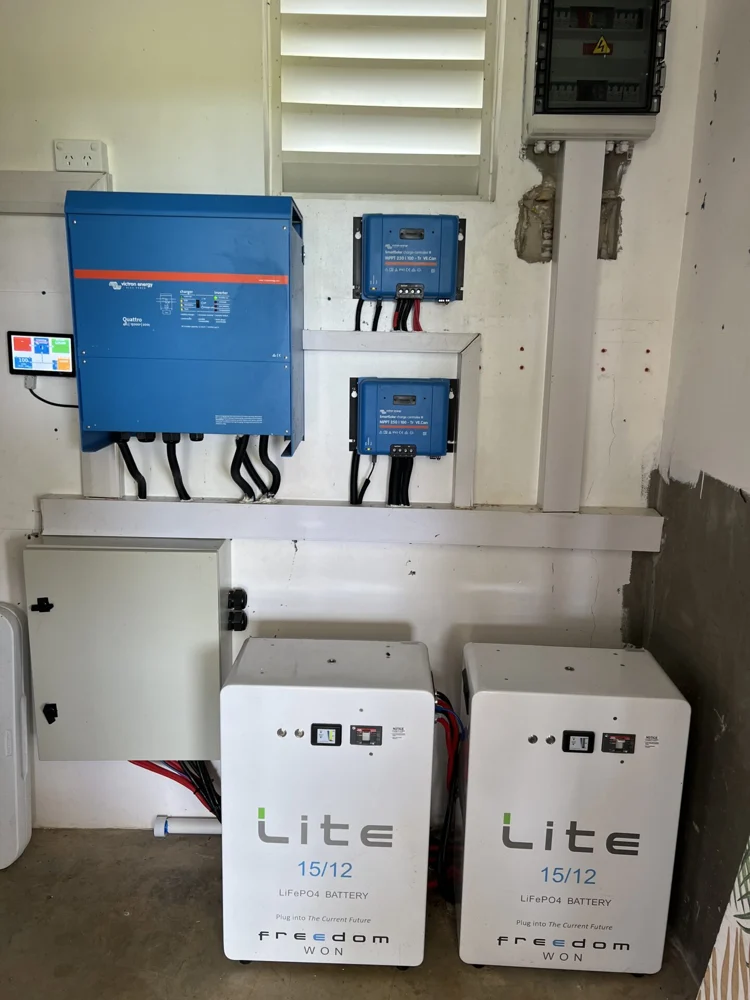
Article image: a separate FWA off-grid farmhouse installation in Vanuatu, shown in the FWA project gallery. It is not a photograph of Lolowai.
What was retained and what changed?
| System element | Lolowai system |
|---|---|
| Solar | 50kW existing array retained and integrated |
| Hybrid inverter | 150kW ATESS HPS150 |
| Battery storage | 300kWh Freedom Won HV storage: three 100kWh cabinets |
| Generator | Backup with automatic start when required |
Source: Lolowai project sheet, pages 1–2. The figures describe this installation; they are not a universal solar-to-battery sizing ratio.
The project reused existing solar while restoring storage for use outside sunshine hours. For a remote site with serviceable generation, this is a useful procurement question: what can be retained, and what must change to make the whole system work?
Start with an energy budget and a power schedule
List the equipment that must run, its operating hours and whether demand changes seasonally. Separate essential loads from those that can be scheduled or curtailed. Record simultaneous demand and starting requirements independently from daily energy use.
Build the budget around the site's operating cycle. A clinic, workshop and accommodation facility may need energy at different times even when their daily totals are similar. Identify the period the battery must cover and the minimum reserve the operator wants available at its end.
Agree a practical hierarchy of loads
Work with the site operator to identify which services must continue and which activities can move to another time. Record who can authorise a change to normal operation and what information they need before doing so. For a facility serving a community, make those priorities explicit rather than leaving them to be decided during a low-energy period.
Prepare separate descriptions of normal operation, reduced operation and recovery. Ask the designer to show the loads served in each case and the assumptions about charging or generator availability. If a proposed design depends on deferring an activity, confirm that the operator can actually make that change.
Include planned additions to the site in this exercise. A future building or longer service hours should be assessed against both the energy budget and the available power. Keep those future requirements separate from the loads the initial installation is contracted to support.
Use a transparent preliminary calculation
Consider a hypothetical critical load averaging 5kW for twelve hours without charging. Its energy requirement is 5 × 12 = 60kWh. If an initial calculation assumes an 80% usable battery fraction and 90% inverter efficiency, nominal capacity would be 60 ÷ (0.80 × 0.90) = approximately 83.3kWh.
These are illustrative assumptions, not Freedom Won product specifications or a Lolowai performance model. The calculation excludes auxiliary consumption, ageing allowances and a separate reserve. It also does not check peak power. A designer must replace the assumptions with the selected equipment's documented limits and the site's measured loads before sizing a system.
Test the sensitivity of the example before treating the estimate as useful. If the same hypothetical 5kW load must run for fourteen hours, its energy requirement becomes 70kWh. Keeping the illustrative 80% usable fraction and 90% inverter efficiency gives 70 ÷ 0.72 = approximately 97.2kWh, with the same exclusions. The changed duration alone alters the preliminary requirement.
For a real assessment, ask which inputs are measured and which are assumptions. Prioritise verification of the uncertain inputs that could materially change the equipment selection. This is particularly useful when an existing site has limited monitoring or when future operating hours are still being decided.
Check the ability to recover after poor weather
Storage capacity alone does not answer how the battery will recharge while daytime loads continue. Ask for a time-based energy balance covering the chosen design conditions: solar serving loads, surplus available for charging, battery recovery and any generator contribution.
Distinguish daily recovery from storage capacity
As a separate hypothetical example, suppose a system has a 60kWh energy deficit and receives 40kWh of net stored-energy gain each day after daytime loads and all assumed losses. Restoring that deficit would require 60 ÷ 40 = 1.5 daily increments of that gain. This is an energy-balance illustration, not a recharge-time prediction or an estimate based on Lolowai's solar array.
Ask the designer to show the actual time sequence for the site, including the overnight demand between charging periods. State when the system is expected to return to its target reserve and what happens if conditions remain unfavourable. A proposal should make the role of the generator visible within that sequence, rather than using battery capacity alone to imply independence from backup.
Ask the operator to confirm the assumptions about fuel availability and generator readiness. A recovery model should identify when backup is required and whether the operating plan can provide it under the assessed conditions.
- Provide measured load information and a seasonal operating calendar.
- Confirm the condition and integration requirements of existing solar equipment.
- Define generator-start priorities and the loads that must remain supported.
- Include a low-solar sequence and subsequent recovery in the assessment.
- Agree local operating procedures, remote monitoring access and service responsibilities.
Plan support around the remote location
Discuss which checks the local operator can perform and which require specialist support. Ask who receives alarms, what records can be accessed remotely and what happens if communications are unavailable. Identify the contact responsible for coordinating a service visit and the information needed before that visit is arranged.
Include delivery, access and replacement arrangements in the proposal discussion. Retaining existing solar is a defined part of the Lolowai account; for another site, ask for an assessment of the equipment proposed for reuse and the work required to integrate it. Record any investigation that remains outstanding before the final design is accepted.
Interpret the early generator observation correctly
During the first three weeks at Lolowai, no generator starts were recorded on good sunny days. Diesel remained available as backup. To assess generator use across a full year, track demand, solar production and fuel consumption through representative seasons, including extended cloudy periods. Source: commissioning-period observation, page 2.
Design the reporting around questions the operator can act on. Were generator starts associated with higher demand, poor solar conditions, a chosen reserve setting or an equipment issue? Were any loads deferred, and was the intended supply maintained? Record those circumstances with the readings. This makes a short observation period informative while preserving the distinction between an operating event and an annual result.
For an ongoing assessment, request records that connect weather, load, battery state and generator operation over representative seasons. Keep measured results separate from forecasts when presenting the business case.
Use the inverter compatibility guide for equipment questions and the LCM Store case study for a different integrated project. Send FWA your remote-site load and generation details to discuss suitable battery storage, with applicable documentation available through downloads.
Frequently asked questions
What equipment does Lolowai use?
The project uses 300kWh of Freedom Won high-voltage storage, comprising three 100kWh cabinets, 50kW of retained solar and a 150kW ATESS HPS150 hybrid inverter.
Can I copy Lolowai's equipment ratios for my site?
No. Your loads, charging opportunities, operating priorities and low-solar conditions must determine the design. The case study is a reference installation, not a universal sizing template.
Did Lolowai eliminate annual generator use?
No. Diesel remains available as backup. No generator starts were recorded on good sunny days during the first three weeks, but that does not establish generator-free operation throughout the year.