
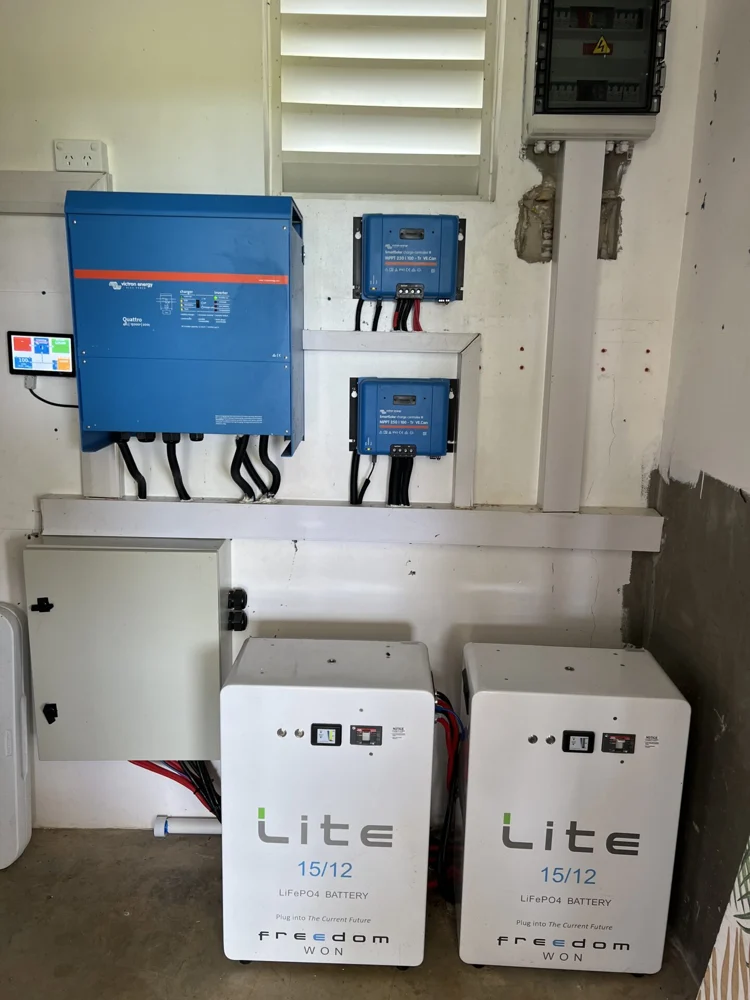



For an off-grid property, storage is part of the everyday electricity supply. The battery, inverter, solar generation and any generator need to work as one planned system. When designing around SMA, Studer or MLT Power equipment, select the exact inverter and controls alongside the Freedom Won battery, with capacity for daily use and a clear plan for periods of low solar production.
This guide is for owners comparing a new system or upgrading an existing installation. It explains the integration questions associated with these brands, the measurements that help determine battery size and the information Freedom Won Australia needs to begin a useful product discussion.
SMA: distinguish Sunny Island from other product families
SMA Sunny Island is a battery inverter used in off-grid, self-consumption and backup arrangements. Lithium installations require a supported battery combination for the specific model. Identify the Sunny Island version and system configuration before selecting Freedom Won storage, particularly when upgrading older equipment. Read SMA’s intended-use guidance and supported-battery requirements.
For a Sunny Island enquiry, provide the full inverter designation and proposed battery model. If the installation has several inverters, include the phase arrangement and how the units are coordinated. These details help establish the operating limits and the equipment needed for the complete system.
For an existing rural property, the original installation diagram and commissioning documents are valuable. They help the project team understand the solar connection, generator interface and equipment already in place. A battery replacement should be assessed in that whole-system context.
Studer: include the communications equipment in the design
Studer’s Xcom-CAN interface enables communication with supported lithium battery management systems. Xtender and next3 arrangements have different integration requirements, so include the inverter family and communications hardware in the design. Selecting these together with the battery helps ensure that the devices can exchange the information needed for coordinated operation. View Studer’s battery compatibility resources.
For a Freedom Won enquiry involving Studer equipment, list the inverter, charge controllers and communications accessories already installed. Ask the proposal to identify any additional interface hardware and the supported battery configuration. A complete equipment schedule is more useful than an assumption that the inverter alone determines compatibility.
The owner should also understand how the system reports battery condition and operating limits. Ask for a demonstration during handover and agree who will support the complete arrangement. This helps prevent confusion when the battery, inverter and monitoring equipment have different brand names.
MLT Power: establish the product and generation
For an MLT Power installation, identify the model and equipment generation before selecting lithium storage. CAN-bus support can differ between generations. Photographs of the labels, the original manuals and details of any communications accessories help establish the available upgrade path.
Describe whether the battery is intended to replace ageing storage, increase usable capacity or support additional loads. These are separate objectives. A replacement may preserve much of the original system, while a major increase in demand can require a broader assessment of the inverter, charging capacity and site infrastructure.
Ask for a written account of the supported battery interface and the commissioning scope. That record should remain with the property’s documents. It will help a future service technician understand the arrangement without relying on an owner’s memory of the original installation conversation.
Measure the loads that determine daily operation
Start by separating continuous demand from occasional loads. Refrigeration and communications may operate through the night; water pumping or workshop equipment may be scheduled. Seasonal heating, cooling or occupancy can change the picture substantially. A yearly consumption estimate alone does not reveal those operating patterns.
As an illustrative calculation, an average 2kW demand over twelve hours requires 24kWh at the loads. A separate 3kW pump operating for two hours adds 6kWh. If those periods are additional, the energy total is 30kWh. This is a load calculation, not a battery specification: the design must also account for usable capacity, losses, reserve and how the equipment operates together.
Power peaks deserve their own review. A battery with sufficient energy for the night may still be unsuitable for a demanding start or a large combination of simultaneous loads. Read our kW and kWh guide before comparing equipment ratings.
Plan for difficult weather and changing demand
A useful off-grid proposal explains operation during more than a typical sunny day. Ask how the system will respond to several low-generation days, increased occupancy and maintenance downtime. If a generator is included, document its intended role and the information needed to coordinate it with the battery system.
Agree which loads can be deferred when energy is limited. Moving a flexible activity into a suitable generation period may affect the storage requirement. The final choice should reflect the owner’s priorities and practical constraints. A lifestyle that depends on uninterrupted high demand needs a different design from one with substantial scheduling flexibility.
These decisions should be made during planning. The owner should not have to discover the limitations through unexpected interruptions after installation. Clear operating scenarios give the proposal a measurable purpose and help the installer explain what the selected equipment can deliver.
Apply the lessons from other off-grid projects
Remote installations show why storage must be considered alongside generation and conversion. Lolowai combines 300kWh of battery storage, 50kW of existing solar and a 150kW ATESS inverter to serve a village and clinic. Explore our FWA project collection and Lolowai design article to see how load timing, reserve and generator support shape a complete design.
Our Victron integration guide explores another approach to off-grid and backup systems. Across these applications, the useful lesson is to size storage against the site’s demand and charging opportunities, then select the appropriate conversion and control equipment. Your SMA, Studer or MLT proposal should explain how its own combination will meet those requirements.
Select a battery and a support pathway together
Explore the LiTE Home selection guide and Freedom Won product range to understand the available storage families. The appropriate choice depends on the exact inverter relationship and the duty required. Do not transfer compatibility from a legacy battery to a new family without checking its documentation.
Send Freedom Won Australia your project details, including the site location, equipment models, load information and intended generator role. Our reseller and solution-provider directory provides a route to the relevant local conversation. A supported off-grid system brings together suitable products, clear commissioning responsibilities and a practical plan for service over the life of the installation.
Frequently asked questions
Does Sunny Island guidance apply to every SMA inverter?
No. Use the documentation and battery approvals for the specific SMA product family and installed model.
Why are Studer communications accessories relevant?
The supported lithium integration may depend on the appropriate interface hardware. Include the inverter, controllers and accessories in the equipment schedule.
How should an off-grid battery be sized?
Use measured or representative demand, peak-power requirements, seasonal generation, reserve and the intended generator role. Nominal battery capacity alone is insufficient.
Related reading
Sources & documentation
Technical references: Freedom Won Australian interfacing guide. Product datasheets, manuals and project case studies: FWA downloads.