
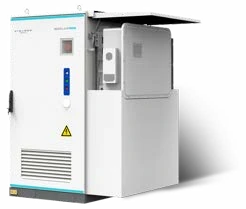




A commercial battery project involves more than selecting storage capacity. Power conversion, site controls, metering and existing solar all influence how the installation operates. When assessing Solis, Kehua, Ingeteam, Socomec, ABB or Delta equipment, identify the job each device will perform and how it fits with the proposed Freedom Won storage.
Begin with the commercial objective: shift solar into evening use, support selected loads or manage demand at particular times. Then compare equipment architectures against that objective. A clear design assigns responsibility for battery integration, controls and commissioning, giving you a complete system to assess rather than a collection of independently rated components.
Solis: verify the particular hybrid inverter and battery
For a SOLVA DC261 project, an external Solis 125kW hybrid inverter is one integration option. Confirm the exact inverter variant, voltage range and controls with the project team before ordering. That review should cover the complete battery-inverter arrangement and the operating modes your site needs.
For a SOLVA enquiry, use the DC261 integration guide and the technical brochure. Ask the project team to confirm the exact inverter variant, supported voltage range, control interface and configuration before the equipment schedule is finalised.
Kehua: assess conversion equipment within the complete architecture
Kehua power-conversion equipment can be considered when designing how a larger storage project exchanges energy with the site. Identify the proposed PCS model, its power and voltage limits, and the control arrangement. A project-specific interface review is needed before pairing it with Freedom Won storage. Explore Kehua’s technical downloads.
For an enquiry involving Kehua, identify the proposed PCS model, the battery architecture and the party responsible for system controls. Request an interface review that covers the complete arrangement. A suitable power rating is only one part of that assessment.
Ingeteam: consider the wider plant-control requirement
Ingeteam’s BESS technologies combine power conversion with control and protection functions. These become especially relevant when storage forms part of a larger electrical installation, where several devices need to respond to the same operating strategy. View Ingeteam’s BESS overview.
If Ingeteam equipment is installed or proposed, specify its exact role: solar inverter, battery converter or plant controller. Assign responsibility for verifying the Freedom Won battery interface and commissioning the complete operating sequence. The proposal should establish the supported model combination before equipment is ordered.
Socomec: distinguish storage, switching and monitoring roles
Socomec equipment can serve power conversion, switching or monitoring functions within a storage project. List the devices and their roles so the designer can assess how they work with the battery and site controls. This also makes it easier to compare what is included in competing proposals. Explore Socomec’s stationary-storage information.
List each proposed device and its purpose. Where metering is used to control battery operation, the designer should specify the measurement point and how the information reaches the controller. Where conversion equipment is proposed, request model-specific battery-interface evidence. Keeping those roles clear makes procurement and commissioning easier to review.
ABB: identify legacy solar equipment and current support
ABB completed the divestment of its solar-inverter business to FIMER in March 2020. That history matters when assessing an existing site with ABB-labelled solar equipment: the label alone does not identify the current support pathway or establish a battery interface. Read ABB’s transaction announcement.
ABB equipment can also perform other electrical roles. Provide the exact product identity and installation documents so the project team can distinguish solar conversion, metering, protection or switching functions. A battery retrofit should be designed around the existing system’s verified capabilities, rather than treating all ABB devices as storage inverters.
Delta: review the PCS, controller and battery together
Delta’s commercial storage architectures bring together bidirectional power conditioning, batteries, site controllers and energy management. When considering Delta equipment for a Freedom Won project, assess those functions together so power conversion and operating controls match the site’s requirements. Explore Delta’s storage architecture.
The engineering review should name each device, establish the battery interface and communications, and allocate commissioning responsibility. Include the required operating modes, metering points and any existing equipment to be retained. These details define the proposed system and provide a basis for accepting it at handover.
Choose the Freedom Won architecture before comparing totals
The SOLVA range distinguishes products with integrated conversion from products designed around an external inverter arrangement. The SOLVA comparison guide explains these differences. A nominally similar storage capacity can therefore represent a different equipment scope and a different integration task.
The SOLVA AC261 combines 261kWh of total storage with an embedded 125kW PCS. Dividing energy by rated power gives approximately 2.09 hours before allowing for usable-energy limits, reserve and losses. Actual runtime depends on the load. Comparing both ratings helps you assess how much energy can be stored and how quickly it can be delivered.
Make the project objective measurable
Specify the business outcome before asking for equipment prices. A warehouse may want to shift daytime solar into evening operations. A facility with critical loads may prioritise a defined backup duty. Another business may want to reduce demand during a particular tariff period. Each objective needs a suitable measurement and a clear starting baseline.
As a separate illustrative example, supplying an additional average 40kW for three evening hours requires 120kWh at the loads. That calculation does not determine the battery model, but it gives the designer an explicit requirement to assess. Include seasonal variation and explain which loads can be deferred if necessary.
Our commercial storage guide explains the information to collect. Interval consumption, existing solar data, the electrical arrangement and the intended operating schedule are more useful than an annual bill alone.
Bring the technology discussion back to the site
Use our project collection to understand the scale and applications of Freedom Won storage. The LCM Store article distinguishes its 885kWh installed capacity from a proposed future expansion. That separation is useful when deciding which infrastructure must be installed now and which options should remain available later.
Contact Freedom Won Australia with the site location, project objective, existing equipment and any preferred conversion brand. Include the proposed responsibility for design and installation. FWA’s product resources and solution-provider network can help turn the initial technology shortlist into a focused discussion about a supported storage system.
Frequently asked questions
Can I choose commercial equipment by brand and power rating alone?
No. The battery voltage range, communications, controls and supported operating modes must also suit the exact equipment combination. Confirm these as part of the system design.
Why does the role of ABB-labelled equipment need checking?
ABB equipment can perform different electrical functions, and its solar-inverter business was divested to FIMER in 2020. Identify the product and relevant support pathway.
What information starts a commercial integration enquiry?
Provide the location, operating objective, consumption profile, existing electrical arrangement and exact proposed battery, conversion and control equipment.
Related reading
Sources & documentation
Technical references: Freedom Won Australian interfacing guide. Product datasheets, manuals and project case studies: FWA downloads.