
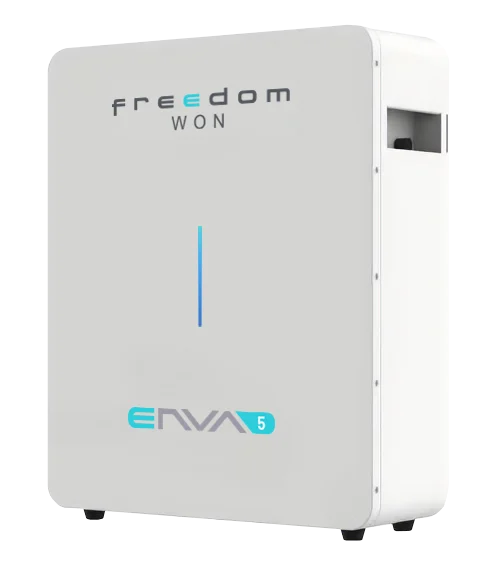
The Freedom Won ENVA 5 deserves consideration when your home battery brief starts with a defined group of loads: evening lighting, communications, refrigeration or a home office. The useful question is how much energy those loads need, how strongly they draw at the same time, and whether you want them supported during an outage.
ENVA 5 is a compact battery option in the 5kWh class, with 5.12kWh of total energy and a maximum 5kW power rating. Match its usable energy and sustained output to your evening loads, backup priorities and inverter when planning the installation. Source: FWA product range.
What do the ENVA 5 ratings actually describe?
| Parameter | Specification |
|---|---|
| Total energy | 5.12 kWh |
| Energy at 80% depth of discharge | 4.1 kWh |
| Energy at 90% depth of discharge | 4.6 kWh |
| Maximum discharge power | 5 kW |
| Maximum/continuous discharge current | 100 A / ≤50 A |
Source: ENVA 5 specification sheet, pages 1–2. Maximum-current operation is limited to five minutes in each 30-minute cycle and is subject to temperature conditions. Use the continuous ratings and inverter limits when assessing sustained supply to your appliances.
Depth of discharge describes the fraction of stored energy discharged. The energy rows above are battery-side figures. Your proposal should identify the operating window, conversion losses, reserve settings and inverter limits that determine what reaches the selected circuits.
Build an evening energy budget
Start with measured consumption where available. Separate appliances that operate for hours from equipment used briefly. The following numbers are invented planning inputs, not typical appliance consumption or an ENVA performance prediction.
| Assumed load group | Average power | Duration | Energy |
|---|---|---|---|
| Selected background loads | 0.35 kW | 6 hours | 2.10 kWh |
| Additional evening equipment | 0.80 kW | 1 hour | 0.80 kWh |
| Total | Assess overlap separately | As above | 2.90 kWh |
The calculation is 0.35 × 6 + 0.80 × 1 = 2.90 kWh. If both groups operate together, their assumed combined demand is 1.15 kW, before any starting surge. This gives your designer an energy target and a power question. It does not establish runtime: available charge, losses, battery condition and reserve must still be assessed.
Repeat this exercise for a demanding evening as well as an ordinary one. Include changes such as a longer work-from-home day or additional cooling. An average that hides those variations can make a proposal look more suitable than it is.
Test timing as well as total energy
The evening example also lets you test a practical household choice. Suppose the additional 0.80 kW equipment could run immediately after the six-hour background period instead of during it. Under those same hypothetical assumptions, total energy remains 2.90 kWh, but the greatest running demand falls from 1.15 kW to 0.80 kW. The support period now extends to seven hours. This is a change in the load schedule, not a claim about battery capability.
Discuss whether that timing is realistic before building it into a proposal. A system that depends on an inconvenient routine may not suit the household. Record which activities can move, which must happen together and which vary with visitors or working hours. The designer can then assess an ordinary schedule and a demanding schedule without assuming that everyone will reorganise their evening.
Make backup a separate design decision
Daily use and outage support need separate settings and expectations. A battery installation provides backup only when configured for that role. Source: Australian Government battery guide.
List the circuits you want retained, the duration you want assessed and the appliances you can pause. Ask what happens if an outage begins after the battery has already supplied the evening load. Also ask whether solar can recharge the proposed system while the grid is unavailable.
Check whether the evening pattern can repeat
An evening energy budget becomes more useful when it is paired with a charging brief. Provide available daytime solar and consumption records, then ask the designer to show when the proposed battery could replenish the energy allocated to evening use. Identify whether the figures describe electricity at the household circuits or energy entering the battery, so the comparison allows for conversion consistently.
Include days when someone is home and days when the property is empty. Ask what changes if the daytime load is higher than expected or the charging opportunity is shorter. The aim is to understand the operating plan, including when the household would continue using grid electricity, rather than assume the battery starts every evening fully charged.
For backup, ask for a second explanation showing the chosen reserve. Clarify whether that reserve is available only during an outage and how it affects routine evening supply. Keep these assumptions beside the load schedule so a later change in priorities can be assessed against the original brief.
Check the whole system before selecting the battery
- Give FWA the exact existing inverter model and any available system documentation.
- Ask for the proposed continuous and short-duration AC output, with their conditions.
- Confirm how much daily energy is allocated to normal use and how much is reserved.
- Provide photographs and dimensions of the proposed battery location for assessment.
- Identify who will commission monitoring and explain the operating settings.
Use the FWA inverter compatibility information to check the exact equipment combination. Collect the applicable manuals through downloads, rather than assuming a shared inverter brand name settles compatibility.
Make the handover useful to the household
Before selecting the proposal, describe the questions you want answered at handover. These might include how to recognise normal charging, where to see the battery's state of charge, and how to tell which circuits are supported during an interruption. Ask which information the proposed monitoring arrangement actually provides and who explains any settings that affect daily use.
Request a walkthrough of an ordinary evening and the agreed outage scenario with the installer. It should connect the displayed information to the operating brief, including the reserve and any loads the household has agreed to pause. This helps everyone understand the installed system without treating a display percentage as a promise of remaining hours.
Keep the final circuit list and operating assumptions with the equipment records. If your routine changes, such as extending home-office hours, you can ask FWA to reassess that specific change instead of starting with a vague request for more battery capacity.
When should you compare a larger option?
Use the larger-battery comparison to identify the actual constraint. If the evening window is too short, ask how much additional delivered energy would address it under the same assumptions. If a particular appliance combination is the issue, ask whether battery discharge limits, inverter output or the selected circuits set the restriction. Increasing the kWh figure alone does not answer that question. Also ask whether the proposed larger configuration changes the location or integration scope, so the comparison includes the complete installation.
If the load exercise reveals a longer evening requirement, compare the ENVA 16 home and business battery. If staged expansion is central to your plan, read the eTower modular battery guide. Our kW and kWh sizing guide helps organise the numbers.
Ask Freedom Won Australia about ENVA 5 with your evening energy budget, inverter details and backup priorities. That turns a product enquiry into a clear brief for a system that fits your household.
Frequently asked questions
Is ENVA 5 a 5 kWh or 5.12 kWh battery?
ENVA 5 belongs to the 5kWh capacity class and has 5.12kWh of total battery energy. Use the exact specification and intended operating window when reviewing a proposal.
Can ENVA 5 supply 5 kW continuously?
The 5kW figure is a maximum discharge rating, subject to current, duration and temperature limits. For sustained supply, assess the battery’s continuous ratings together with the inverter and the intended loads.
Will ENVA 5 keep my whole home running during an outage?
That depends on the selected circuits, loads, inverter and backup configuration. Define essential circuits and ask the designer to assess their simultaneous demand and required duration.
What should I send with an ENVA 5 enquiry?
Send interval consumption or a load schedule, existing inverter details, location photographs and the circuits you want supported. Include expected changes to household electricity use.