
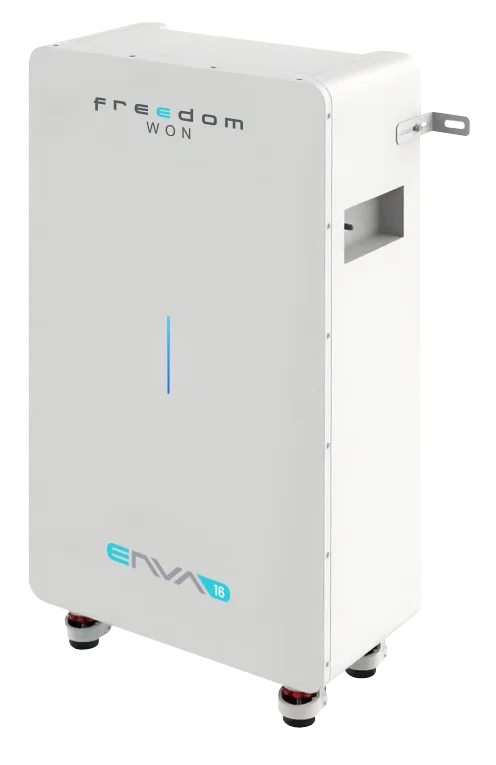
A larger household and a small business can need similar amounts of stored electricity for very different reasons. One may have a long evening load; the other may need a concentrated period of support after solar generation falls. ENVA 16 is a useful product to assess when those requirements call for more stored energy than a small entry system.
ENVA 16 combines 16kWh of total battery energy with a maximum 10kW power rating. For homes and businesses, the useful comparison is how much energy the proposed system can deliver over the required period and which loads it can support together. Source: FWA product range.
Read capacity and output as separate specifications
| Parameter | Specification | Selection question |
|---|---|---|
| Total energy | 16 kWh | How much is allocated to your operating window? |
| Energy at 80% depth of discharge | 12.8 kWh | What remains after conversion and any additional reserve? |
| Maximum discharge power | 10 kW | What continuous AC power does the complete system provide? |
| Maximum/continuous discharge current | 200 A / ≤157 A | Which conditions apply to sustained demand? |
Source: manufacturer ENVA 16 specification sheet, pages 1–2. Maximum current is limited to five minutes per 30-minute cycle, with temperature qualifications. A 10 kW maximum-power label therefore does not establish continuous 10 kW delivery to appliances.
The floor-standing enclosure has adjustable feet and wheels for initial positioning. Discuss the actual location, access and securing arrangement during the site assessment. Source: ENVA 16 physical parameters.
Compare two loads with the same energy requirement
Consider these hypothetical profiles. The assumed power is constant over each stated period; the figures are calculation inputs, not typical home or business consumption.
| Illustrative requirement | Calculation | Energy at the loads |
|---|---|---|
| Household evening | 2 kW × 5 hours | 10 kWh |
| Business operating period | 5 kW × 2 hours | 10 kWh |
Each target is 10 kWh, but the business scenario requires 2.5 times the sustained power. The household scenario needs support for longer. Neither row proves that ENVA 16 will meet the requirement: the designer must account for operating limits, inverter conversion, available charge and reserve. Equipment starting loads also need a separate check.
This comparison gives you a better way to discuss alternatives. Ask for an explanation of how the proposed system meets both the energy target and the sustained power requirement, rather than selecting whichever quote shows the largest kWh number.
Include the hours around the main load
The two 10 kWh examples describe only their nominated periods. To extend the business example, assume an additional constant 0.5 kW load runs for eight hours after the two-hour operating period. That adds 0.5 × 8 = 4 kWh, bringing the delivered-energy target to 14 kWh. All inputs are hypothetical, and there is no solar contribution during either period.
The sustained demand during the first period remains 5 kW, but the energy brief has changed substantially. This is why a business enquiry should identify closing procedures and equipment left running overnight. It also shows why a battery's total capacity cannot be compared directly with only the busiest part of the day.
For a household, apply the same discipline to the morning before solar production can contribute. Ask whether that period belongs in the storage brief or whether the intended battery role ends earlier. The answer should reflect the owner's priorities, with the proposal stating the boundary clearly.
Use the right information for your property
For a home, identify electricity used after solar production declines, early-morning consumption and any planned electrification. For a business, separate trading hours, overnight equipment, weekends and seasonal activity. The Australian Government recommends using meter data and considering future electricity needs when planning a system. Source: government design considerations.
Look for an ordinary day and a difficult day. A quiet weekend should not stand in for a busy operating day. Conversely, a one-off event should not silently determine the size of every daily cycle. Give the designer enough context to explain the chosen design case.
Check charging, integration and backup together
Stored energy has to be replenished. Supply solar generation and export records alongside consumption, and ask when charging is expected to occur. If the battery supports evening demand, identify the next charging opportunity. If backup is also a priority, specify how much energy should remain available before that opportunity arrives.
Ask for a replenishment timeline
Consider a separate, hypothetical charging exercise: the operating plan needs to restore 8 kWh at the battery. If the average power actually entering storage were a constant 2 kW, the arithmetic would be 8 ÷ 2 = four hours. At a constant 4 kW, it would be two hours. These are assumed battery-side rates, not ENVA 16 charging specifications or predicted charging times.
The exercise provides a question for the designer: does the available charging period suit the intended daily use? Ask how the proposed charging rate is constrained, what supplies it, and what happens while the property is also consuming electricity. A maximum rating alone does not describe an average rate across a complete charge.
Have the proposal identify what changes when charging cannot finish before the evening or operating period begins. This could affect the allocation between normal use and backup. Ask for that behaviour to be explained for the actual configuration, including the starting-charge assumption used in any duration estimate.
- Record the existing solar and battery inverter models, where applicable.
- Separate routine loads from circuits nominated for outage support.
- Ask for sustained AC output and short-duration capability to be stated separately.
- Identify the charging assumptions behind the proposed daily operating pattern.
- Confirm the battery document revision, monitoring arrangements and commissioning scope.
Check the proposed equipment combination through FWA's inverter compatibility information. The downloads centre provides the product documents to review alongside the design.
Review alternative proposals on equal terms
Prepare one agreed load schedule and ask each proposed configuration to address it. A household comparison should use the same evening and morning periods; a business comparison should use the same operating day and overnight loads. Keep the backup scope and reserve assumption consistent, or have their differences explained explicitly.
Then examine the proposed delivered energy, sustained output and charging timeline together. If a configuration appears to support more hours, establish whether that comes from additional storage, a different reserve or fewer nominated loads. If it supports greater simultaneous demand, ask which battery and inverter limits allow that result. This makes the comparison useful without relying on a single headline number.
Finally, identify the responsibilities included in the proposal: equipment selection, integration review, commissioning, monitoring setup and explanation of the operating strategy. A clear ENVA 16 proposal should show how those pieces support the agreed use case. Retain that brief so later equipment changes can be evaluated against the same assumptions.
Separate scheduled expansion from uncertain possibilities. A new process with known operating hours can be modelled explicitly; an unspecified future increase should be recorded as a scenario, rather than hidden inside the daily load.
Choose the next comparison deliberately
If your measured requirement is smaller, the ENVA 5 guide helps frame an essential-load brief. If the main requirement is adding capacity in stages, review the eTower expansion guide. Business owners can also use the commercial battery storage guide to organise site information.
Request an ENVA 16 assessment from Freedom Won Australia with your load profile, existing equipment and operating priorities. Ask for a proposal that explains the selected configuration in the context of your home or business.
Frequently asked questions
Is ENVA 16 suitable for both homes and businesses?
It can be assessed for either application. Suitability depends on the property's energy use, simultaneous demand, charging opportunities and integration requirements, rather than the property label alone.
Does 16 kWh mean I receive 16 kWh at my appliances?
No. Total battery energy differs from energy delivered after the selected discharge window, conversion losses and reserve settings. Ask for the proposed usable-energy assumptions.
Does the 10 kW headline describe continuous household output?
It is the product's maximum-power label. The specification gives separate current limits and duration conditions; the inverter and system design determine the usable AC output.
What is the most useful comparison with a smaller battery?
Compare the same load schedule, backup reserve and charging assumptions. Ask which requirement changes the selection: duration, sustained power, expansion or the proposed operating window.