
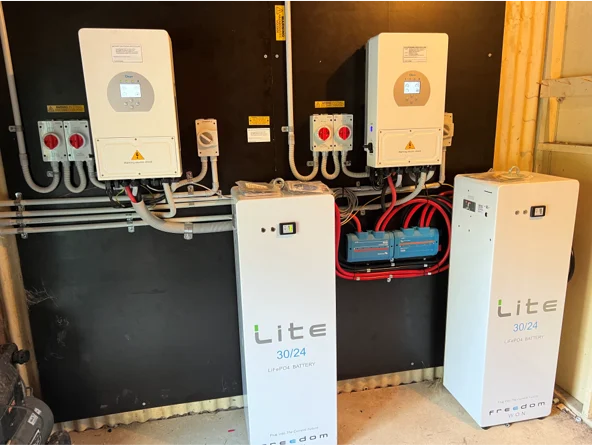
Choosing a Freedom Won LiTE Home battery starts with the complete model name and its matching document. The numbers in a name such as 15/12 relate to energy capacity; they should not be read as an inverter power rating. A useful comparison considers the required energy, sustained output, existing equipment and intended operating settings together.
LiTE Home 10, 15, 20 and 30 models provide different storage capacities for household and business loads. Start with the exact model and generation when assessing an existing installation, replacement or expansion. Find the individual specification sheets in our document centre. Source: FWA downloads index.
Decode the LiTE Home model names
| Model and source | Total energy | Energy at 80% DoD | Energy at 90% DoD |
|---|---|---|---|
| Home 10/8 | 10 kWh | 8 kWh | 9 kWh |
| Home 15/12 | 15 kWh | 12 kWh | 13.5 kWh |
| Home 20/16 | 20 kWh | 16 kWh | 18 kWh |
| Home 30/24 | 30 kWh | 24 kWh | 27 kWh |
DoD means depth of discharge. The second model number indicates battery energy at 80% DoD. Energy delivered to household circuits also depends on the operating reserve, conversion losses and inverter.
The 10/8, 15/12 and 20/16 models have a recommended 80% DoD for average daily discharge and a 90% normal-operation maximum. Use the instructions for the exact model and revision when setting an operating window. Source: Home 10/8 notes; Home 15/12 notes; Home 20/16 notes.
Separate a longer runtime target from a higher power requirement
Home 15/12 and Home 20/16 illustrate why energy and power need separate comparisons. Their FWA-linked sheets show 12 and 16 kWh respectively at 80% DoD, but both list 15 kVA as the maximum recommended continuous inverter rating. Home 15/12 sheet; Home 20/16 sheet.
That is a 4 kWh increase in the stated battery-energy window, without an increase in that inverter recommendation. The two models also have different battery-current limits. Have the designer compare those limits and the actual inverter output against your loads; kVA should not be silently substituted for kW.
Choose adjacent sizes around a defined requirement
Use the load schedule to decide which model comparison is useful. If the main concern is supplying selected circuits for longer, ask how much additional delivered energy that period requires. If the concern is running equipment together, identify the simultaneous demand and ask which battery and inverter limits apply. These questions may lead to different configuration choices.
For an existing LiTE installation, distinguish an ordinary operating day from a demanding one. Record when the present arrangement stops supporting the intended loads, what the battery charge indication shows and which equipment was operating. Give that information to the installer for assessment; the observations alone do not establish whether capacity, settings, charging or another system factor caused the result.
Ask for a comparison using the same circuits, duration and reserve assumptions for each candidate. This makes the difference between adjacent sizes easier to understand and avoids treating a larger model name as a complete explanation of suitability.
Test the energy requirement with explicit assumptions
Suppose the selected circuits average 1.25 kW for eight hours, with no solar contribution. Their energy requirement is 1.25 × 8 = 10 kWh. These are illustrative inputs, not a typical household profile.
For an arithmetic check only, take the Home 15/12 table's 12 kWh energy window and assume 90% discharge-path conversion efficiency, a fully charged battery and no additional reserve or other losses. The result is 12 × 0.90 = 10.8 kWh at the loads, leaving 0.8 kWh against that assumed requirement.
The 90% efficiency is a hypothetical calculation input, not a published LiTE efficiency or a recommended design allowance. It is separate from the DoD percentage. A different reserve, conversion assumption, battery condition or load schedule changes the result. Ask for those assumptions to be stated in the proposal before treating any model as sufficient.
Check how sensitive the example is to a longer evening
Keep the preceding example's assumed 1.25 kW load, but extend its duration from eight to nine hours. With no solar contribution, required energy rises to 1.25 × 9 = 11.25 kWh. Against the same hypothetical 10.8 kWh delivered-energy calculation, the result is a shortfall of 0.45 kWh. An extra hour changes the outcome even though the assumed running power is unchanged.
For comparison only, applying the same hypothetical 90% conversion efficiency to the Home 20/16 table's 16 kWh energy window gives 16 × 0.90 = 14.4 kWh. This remains an arithmetic comparison using the stated assumptions, including full initial charge and no additional reserve or losses. It is not a claim that either model will supply those amounts in a real installation.
Use the exercise to ask how the proposed configuration handles a longer evening. Have the designer identify the relevant operating window and allowances, then assess the actual load record. Changing the assumed duration is a clearer comparison than silently changing the discharge setting to make a smaller option appear sufficient.
Make the replacement brief specific
If you already own a LiTE Home battery, explain why replacement or expansion is being considered. A change in household demand, a new backup requirement and a concern about existing performance call for different assessments. Provide available service findings and operating records alongside the model information so the enquiry starts with evidence about the current system.
Ask which existing components have been assessed for retention and which would change with the proposed configuration. This should cover the inverter, communications, monitoring and physical arrangement. Request an explanation of any settings that must be reviewed when the equipment changes; a familiar product name should not replace that assessment.
Describe the result you want in terms of supported circuits and operating hours. If retaining a particular inverter is a priority, state that early and ask whether it constrains the available options. FWA can then frame the discussion around an assessed system requirement, with the exact generation and available configuration identified in the proposal.
Check generation, availability and the existing installation
LiTE Home and LiTE 2 Home are legacy product families. For a new purchase or replacement, ask FWA about Australian availability, the exact generation and suitable current alternatives. Manuals and specification sheets remain available to support existing installations. Australian document listings; manufacturer archive.
This matters when comparing older records with a new proposal. A familiar capacity label does not establish identical connections, monitoring or operating limits across versions. Keep the model label, serial number, specification sheet and commissioning information together.
- Record the existing battery model, generation and inverter model.
- Provide recent load data and the circuits nominated for backup.
- Identify the required support period and charging opportunities.
- Ask for the applicable discharge window and continuous-output assessment.
- Confirm physical access, mounting arrangement and the scope of replacement or expansion.
Use FWA inverter compatibility information for the proposed equipment combination. If the enquiry involves changing battery generations, have that reviewed explicitly rather than assuming the existing settings can be carried over.
Build a shortlist around the requirement
For another home and business option, read the ENVA 16 guide. For staged modular expansion, use the eTower guide. The kW and kWh sizing guide helps turn your consumption records into a consistent brief.
Contact Freedom Won Australia about LiTE Home selection or replacement with your model records and load requirements. Ask which available configuration fits the brief and which documents will govern the proposed system.
Frequently asked questions
What does LiTE Home 15/12 mean?
LiTE Home 15/12 has 15 kWh total energy and 12 kWh at 80% depth of discharge. The second number is not an inverter power rating.
Should every LiTE Home battery use the same discharge setting?
Use the exact model's applicable documentation and commissioned operating strategy. The FWA-linked sheets have different revision dates; a generic setting should not replace a model-specific review.
Does a larger LiTE Home model always mean a larger inverter?
No. LiTE Home 15/12 and 20/16 both have a recommended maximum continuous inverter rating of 15kVA, despite their different storage capacities. Assess battery energy and inverter power separately.
Can I still buy a LiTE Home battery?
LiTE Home is a legacy range. Contact FWA to confirm Australian stock, the exact generation and a suitable replacement or alternative for your installation. Technical documents remain available for existing systems.