
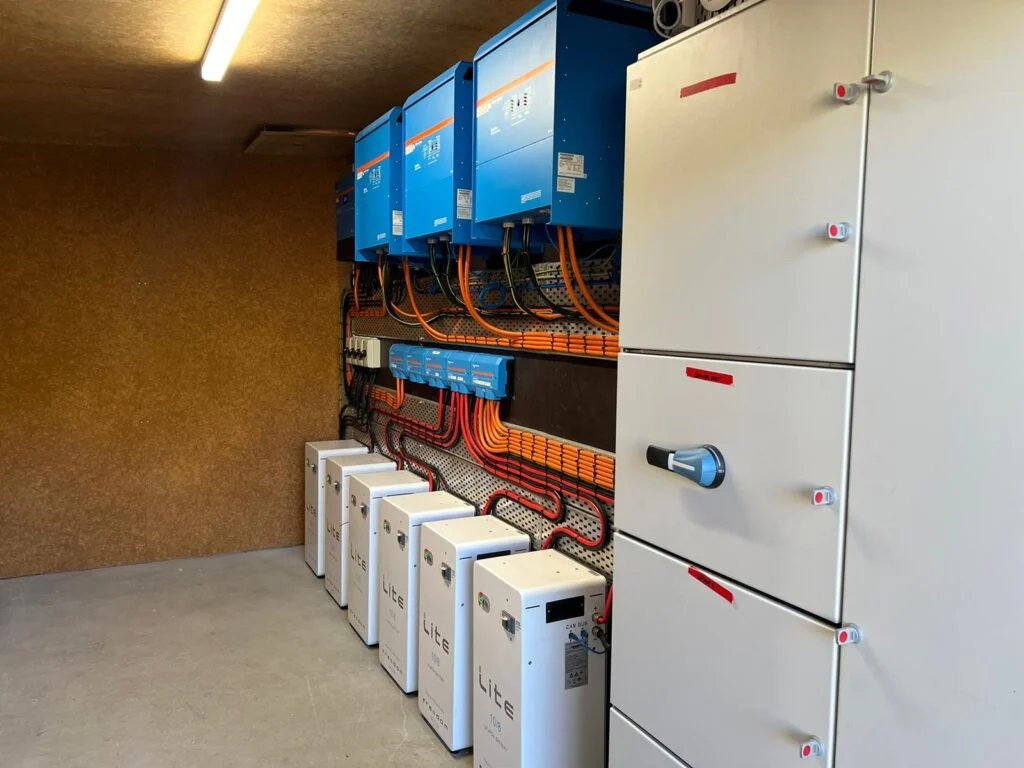
Battery sizing needs two answers: how much power the system must deliver at one time, and how much energy it must deliver over the chosen period. Kilowatts (kW) measure power; kilowatt-hours (kWh) measure energy. Both belong in a useful brief for a home or business battery system. Source: Australian Government solar glossary.
A high energy-capacity figure does not establish that several demanding appliances can run together. Equally, a high power rating does not tell you how long the battery can support them. Start with the loads and their timing, then compare products against that requirement.
Keep three ratings separate
| Measure | Meaning | Question to ask |
|---|---|---|
| Battery energy, kWh | Energy stored or available within a stated operating window | Is this total capacity or energy available for the proposed use? |
| Battery power, kW | Rate of energy delivery | Is the value continuous or a time-limited maximum? |
| Inverter output | Capability of the equipment supplying AC circuits | What output applies to the actual loads and backup arrangement? |
Energy capacity and output power answer different questions. Usable capacity, conversion losses and operating reserve affect delivered energy; outage support also requires an appropriate inverter and electrical configuration. Source: energy.gov.au battery guide. Ask the designer to explain each rating at the point where it applies in your proposed system.
Choose a consistent measurement point
Label where each figure is measured or specified. A battery energy value, electricity delivered to the selected circuits and electricity supplied for charging are different quantities in the assessment. Ask the designer to show the conversion assumptions between them. This prevents a comparison from using a battery-side figure for one option and a delivered-energy figure for another.
Also label how each number was obtained: a product specification, an equipment label, a measured interval or an assumption. A measured average and a stated maximum answer different questions. If the load schedule uses assumed values, identify which ones need checking before final selection.
Keep the time period beside every energy figure. A daily total, an evening total and an outage target may describe different requirements even when all are expressed in kWh. Consistent labels make the subsequent calculations easier to audit.
Calculate energy from power and time
For a constant load, energy in kWh = power in kW × time in hours. For a changing load, calculate each period separately and add the results. This example uses invented planning inputs, with no solar or other supply contribution during the support period.
| Load group | Assumed average power | Operating time | Energy |
|---|---|---|---|
| Essential background circuits | 0.6 kW | 5 hours | 3 kWh |
| Work equipment | 1.5 kW | 2 hours | 3 kWh |
| Additional equipment | 1.0 kW | 1 hour | 1 kWh |
| Total energy | Assess overlap separately | As above | 7 kWh |
The energy sum is 0.6 × 5 + 1.5 × 2 + 1.0 × 1 = 7 kWh. If all three groups operate together at the assumed power, the combined demand is 3.1 kW. Starting surges are excluded and require their own assessment. The 7 kWh target and 3.1 kW overlap answer different sizing questions.
Change timing and duration separately
The load budget allows two distinct tests. First, suppose the additional equipment runs after the work equipment stops, while both still operate within the five-hour background period. With no overlap between those two groups, the highest assumed running demand becomes 0.6 + 1.5 = 2.1 kW. Total energy remains 7 kWh because the individual operating durations have not changed.
For a separate test, retain the original timing assumptions but reduce the work equipment's operating duration from two hours to one and a half. The energy reduction is 1.5 × 0.5 = 0.75 kWh, giving a new total of 6.25 kWh. Its running power while operating remains 1.5 kW. Starting demand is still excluded from both examples.
These hypothetical changes demonstrate why scheduling and reducing operating hours should be assessed separately. Ask whether either change fits the household or business routine before relying on it in a proposal. The calculations describe revised requirements, not an automatic improvement in battery performance.
Translate the load target into a battery-energy budget
For a second calculation, assume a fully charged battery, 90% efficiency from battery energy to the loads, and an accessible energy fraction of 80% after all discharge-window and reserve choices. These percentages are hypothetical, not government recommendations or FWA product specifications.
Illustrative total-capacity requirement = 7 ÷ (0.90 × 0.80) = 9.72 kWh.
This simplified energy-only result excludes ageing, temperature effects and auxiliary consumption. It is not a recommended product size or a prediction of runtime. The 80% accessible fraction already includes the assumed reserve; subtracting that same reserve again would double-count it. A designer should replace these inputs with justified values for the proposed equipment and use case.
Use interval data without losing the power question
The Australian Government recommends obtaining 12 months of interval data where available and examining seasonal electricity use. Source: government system-sizing guidance. Include solar records and label each series clearly as imports, exports, production or total load.
For example, a measured 1.2 kWh over half an hour represents 1.2 ÷ 0.5 = 2.4 kW average power for that interval. It does not reveal the highest instantaneous demand within it. Provide equipment information alongside interval data so short starting loads and simultaneous operation can be assessed.
Also identify planned changes. The government's design guidance asks owners to consider future electricity needs, not only current consumption. Source: design considerations.
Check the recharge requirement and starting charge
In the original 7 kWh example, the assumed 90% discharge-path efficiency means 7 ÷ 0.90 = approximately 7.78 kWh would be removed from the battery. Restoring that energy is a separate charging task. The electricity needed from the charging source cannot be established from this calculation alone because the charging-path assumptions have not been specified.
Ask when replenishment is expected to occur, what energy source is available and how other loads affect that opportunity. Have the designer distinguish a charging power limit from the average charging power assumed over the available period. This connects the energy budget to a repeatable operating plan.
For backup, ask for the same load schedule to be considered at the proposed reserve state, as well as at full charge. Establish which starting condition any duration estimate uses. A calculation that assumes a full battery should remain clearly labelled when discussing an outage that could begin after routine evening use.
Prepare a brief FWA can work with
- State the purpose: routine stored-energy use, defined backup, or both.
- Provide interval data, solar records and existing equipment models.
- List selected loads, operating hours and likely overlaps.
- Identify the support period and starting-charge assumption to assess.
- Ask for energy allowances, continuous power and maximum-power conditions separately.
Then compare relevant options in the Freedom Won Australia range. The ENVA 5, ENVA 16 and eTower guides apply these questions to different product decisions.
Send your sizing brief to Freedom Won Australia, review the applicable sheets in downloads, and confirm the proposed pairing through inverter compatibility information. Request a configuration whose assumptions are as clear as its headline ratings.
Frequently asked questions
What is the difference between battery kW and kWh?
kW measures the rate of power delivery. kWh measures energy over time. A sizing brief needs both simultaneous power demand and the energy required over the chosen period.
Can I divide battery kWh by load kW to find runtime?
That gives a simplified duration only when the energy is genuinely available to the loads and the load is constant. Account for conversion, reserves and operating limits before using it in a proposal.
Does higher battery capacity mean higher output power?
Not necessarily. Capacity, battery discharge limits and inverter output are separate specifications. Check the proposed system's continuous and time-limited power against the actual loads.
Should I size a battery from my average daily electricity use?
Use it as context, then examine timing, solar generation, simultaneous loads and the intended battery role. A daily total alone does not identify the energy required during the chosen support period.