
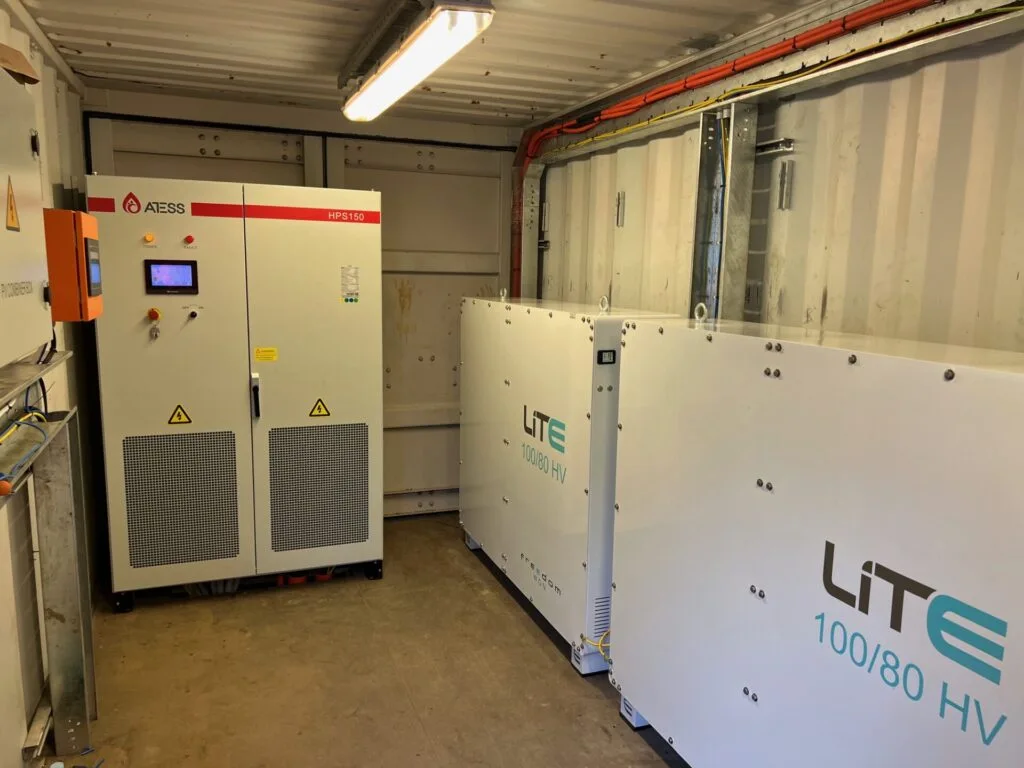

Commercial and remote energy systems often have several jobs to perform at once: use daytime solar, supply evening demand and coordinate a generator when renewable energy is insufficient. ATESS hybrid and battery inverters provide different ways to manage power conversion within that system. Selecting the appropriate Freedom Won storage alongside the conversion equipment helps establish how much energy is available and how it can be delivered.
A successful enquiry begins with the operating requirement. A village clinic, a lodge and a supermarket have different load patterns, even when their annual electricity use is similar. The system should be designed around those patterns, with a documented relationship between the battery, inverter, solar generation and controls.
Where ATESS fits into an integrated system
ATESS hybrid inverters, bidirectional battery inverters and solar charge controllers perform different jobs. The HPS and PCS families therefore need to be selected around the proposed electrical arrangement, not just a power rating. Include the battery interface, controls and supported operating modes in the equipment schedule. Explore ATESS energy-storage equipment.
Freedom Won high-voltage storage and ATESS conversion equipment are used together in integrated energy systems. For your project, specify the battery model, inverter, communications and configuration as one coordinated design. Our inverter compatibility page explains the checks and provides technical documents for the selected combination.
Lolowai: storage for a village and clinic
Lolowai Village and Clinic uses 300kWh of Freedom Won battery storage, 50kW of existing solar and a 150kW ATESS HPS150 hybrid inverter. These ratings describe different parts of the installation: kWh measures stored energy, while kW measures solar or inverter power. Together they show the system’s scale and explain why both energy and power must be considered when planning a remote supply.
During the first three weeks, no generator starts were recorded on good sunny days at Lolowai. Diesel backup remained available for other conditions. For a remote-site owner, the useful lesson is to plan how solar, storage and backup generation will work together as weather and demand change. Read the Lolowai case study and our off-grid design guide for the project context and planning considerations.
Why capacity and inverter power must be assessed separately
Dividing 300kWh by 150kW gives two hours. This is a nominal energy-to-power ratio calculated from the Lolowai figures; it is not the installation’s guaranteed runtime. The calculation assumes all nominal energy is available and ignores losses and reserve. Actual demand may also be much lower than the inverter rating for much of the day.
Consider a separate hypothetical clinic needing an average 8kW overnight for ten hours. Its load would require 80kWh over that period before the system designer accounts for losses and reserve. Starting pumps, refrigeration or other equipment may create short power peaks above that average. The energy budget and the peak-power requirement must both be satisfied. This is why selecting a larger inverter alone cannot solve an inadequate overnight energy allowance.
Document the generator’s role before choosing equipment
A generator may provide contingency support, meet extended poor-weather demand or serve a planned charging role. Those are different operating strategies. Agree which one applies to the site, how a low-energy condition is recognised and who is responsible for the generator’s maintenance. Include the existing machine’s rating and relevant operating information in the project brief.
For a remote facility, practical support arrangements matter alongside equipment specifications. Ask how faults will be identified, what can be diagnosed remotely and which spare parts should be available locally. A clear escalation path can reduce confusion when several suppliers are involved. The battery, inverter and generator should be covered by an integrated handover rather than three unrelated manuals.
Use measured demand to improve the proposal
Request interval consumption data where it is available. For an off-grid site without suitable monitoring, work with the project team to establish a representative load schedule. Separate continuous loads from occasional equipment, and record seasonal differences. A clinic’s refrigeration demand, a lodge’s occupancy and a village’s evening activities can produce quite different daily profiles.
It is useful to identify at least three conditions: a normal operating day, the highest expected demand and an extended period of low solar production. The designer can then explain how the system responds in each situation. This approach exposes assumptions early and gives the owner a clearer basis for comparing proposals.
Compare integration approaches, not just cabinet sizes
Freedom Won offers storage architectures with different conversion requirements. Our SOLVA AC, DC and RT guide compares embedded conversion equipment, external inverters and rectifier arrangements. Use that comparison to decide which equipment belongs in the battery package and which needs to be specified separately, then confirm the inverter pairing for the chosen model.
For a larger project, the LCM Store case study offers another scale reference: 885kWh of installed storage and 150kW hybrid inverter capacity. Its proposed future expansion is separate from the installed system. Keeping present and future capacity distinct helps owners make realistic procurement and infrastructure decisions.
Define the commercial result you want to measure
A remote-site project might track generator running hours, fuel use and hours of supply availability. A grid-connected business might track solar self-consumption and demand during expensive periods. Establish the baseline before commissioning and agree how the comparison will account for changes in activity or weather. Without that baseline, a percentage improvement can be difficult to interpret.
A useful performance discussion includes the measurement period and the source of the data. Avoid comparing a busy holiday period with a quiet month without explanation. Our commercial battery planning guide outlines how a well-prepared brief can support a more meaningful proposal.
Start an ATESS and Freedom Won project discussion
Send Freedom Won Australia the site location, main loads, existing solar and generator information, and the intended operating outcome. Include any ATESS model already installed or proposed. Our contact page connects that enquiry with the next product and integration discussion, while the partner directory identifies resellers and solution providers.
A coordinated proposal gives you a battery selected for the site’s duty, an inverter matched to that battery and a support plan suited to the location. It should also explain what the system will do during normal operation, peak demand and low solar production. That clarity makes the investment easier to assess and the finished installation easier to operate.
Frequently asked questions
What equipment does Lolowai use?
Lolowai uses 300kWh of Freedom Won storage, 50kW of existing solar and a 150kW ATESS HPS150 hybrid inverter.
Does Lolowai still have generator backup?
Yes. Diesel backup remains available. No generator starts were recorded on good sunny days during the first three weeks; operation in other conditions depends on solar production, demand and reserve.
Are ATESS HPS and PCS products interchangeable?
No. Confirm the particular product’s role, battery interface and supported configuration as part of the complete system design.
Related reading
Sources & documentation
Technical references: Freedom Won Australian interfacing guide. Product datasheets, manuals and project case studies: FWA downloads.